SaaS Development in Nepal 2026
A company starts with an Excel sheet. Then it adds a customer portal, then an online payment option, then an admin dashboard so the team can stop emailing attachments. Six months later, it's running something that looks a lot like a software product, without ever having decided to build one.
That moment is usually where SaaS development begins.
SaaS development is the process of designing and building software that customers access online, usually on a subscription, with each customer's data kept separate and secure. In Nepal, it's now a realistic path for startups building a product, for companies turning an internal tool into something they can sell, and for international buyers who want a reliable engineering team. What it costs and how long it takes depends on scope: features, user roles, multi-tenancy, billing, integrations and security.
This guide covers what SaaS really is, what you can build, which features matter first, how multi-tenant architecture works, what drives cost and timeline, the technology choices, what's different in Nepal, and how to pick a development partner.
What Is SaaS Development?
SaaS stands for Software as a Service. Instead of installing software on each computer, customers log in through a browser or app, and the provider hosts, updates and maintains it. Think of accounting tools, CRMs, school management systems or booking platforms that you pay for monthly or yearly.
SaaS development covers everything needed to make that work:
- The product itself (the features customers use)
-
Accounts, logins and permissions
-
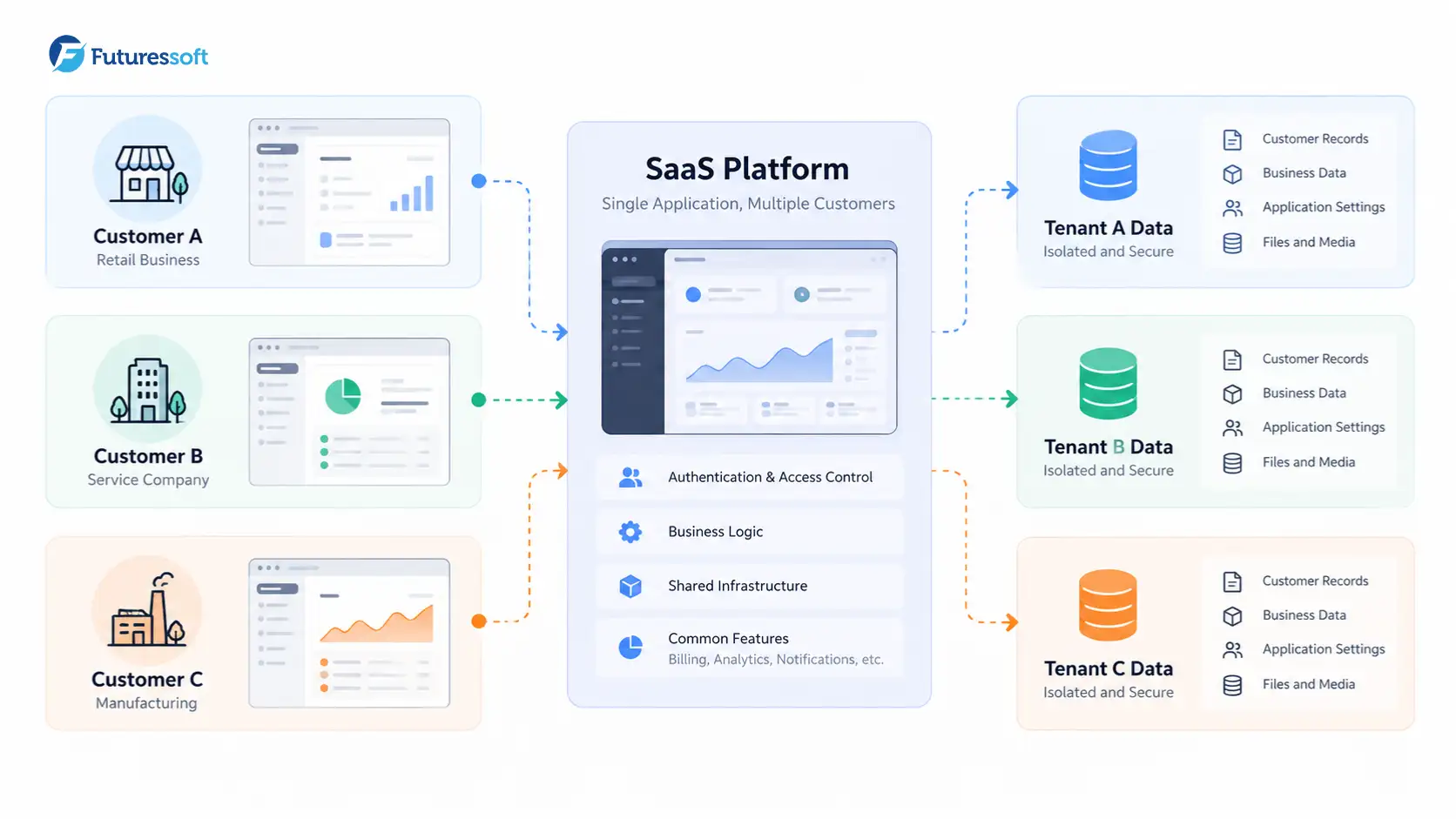
A way to serve many customers from one platform without mixing their data
-
Subscription plans and billing
-
Hosting, monitoring and updates after launch
How Is SaaS Different From a Website or a Normal Web App?
The difference is in who the software is for and how it's sold.
|
Website |
Web Application |
SaaS |
|
|
Main purpose |
Share information |
Help users perform tasks |
Sell software as an ongoing service |
|
Users |
Public visitors |
A defined set of users |
Many separate customer organizations |
|
Login |
Usually none |
Usually yes |
Always |
|
Multi-tenant |
No |
Usually no |
Usually yes |
|
Subscription billing |
No |
Sometimes |
Usually |
|
Customer data isolation |
Not applicable |
Not usually a concern |
Critical |
A web app is often built for one organization. A SaaS product is built for many, and that single difference changes the database design, the permissions model, the billing and the support. If you're still weighing the basics, our guide on website vs web app is a good place to start, and our web application development guide covers the architecture that SaaS builds on.
What Can Businesses in Nepal Build as SaaS?
Almost any repeatable workflow can become SaaS, but some categories fit Nepal's market especially well:
|
SaaS type |
Typical users |
Core functionality |
|
CRM |
Sales teams |
Leads, pipeline, follow-ups |
|
HR & payroll |
Companies |
Employee records, attendance, payroll |
|
School management |
Schools and colleges |
Students, fees, results, attendance |
|
Travel & booking |
Travel agencies |
Packages, bookings, customers, payments |
|
POS & inventory |
Retail and distribution |
Stock, purchases, sales reports |
|
Business management / ERP |
Multi-branch companies |
Accounting, inventory, sales, reporting |
|
Marketplace or platform |
Buyers and sellers |
Listings, orders, payments, reviews |
|
Industry-specific tools |
Clinics, logistics, media, NGOs |
Whatever the sector's daily workflow needs |
Several of these overlap with things we've already written about. A school SaaS shares a lot with a school website plus a management back end. A booking platform draws on travel software development. And a multi-module business tool is close to ERP software offered on subscription.
Do You Actually Need SaaS?
It's worth asking honestly, because SaaS is more work than a standard custom system. It makes sense when:
- You plan to serve many separate customers from one product
-
You want recurring revenue instead of one-off project fees
-
Your workflow is repeatable across different organizations
-
You're willing to invest in ongoing development and support
It's probably not the right move if you only need software for your own team. In that case, plain custom software is simpler and cheaper. Our post on the signs your business needs custom software can help you work out which side you're on.
What Features Does a SaaS Product Need?
The most common mistake is trying to build everything at once. Split the list into what you need to launch and what can wait.
MVP features (launch with these)
-
Authentication: sign-up, login, password reset
-
Roles and permissions: at least admin and standard user
-
The core workflow: the one thing your product exists to do
-
A basic admin dashboard: to manage accounts and see usage
-
Subscription plans and payment: a simple way to charge customers
-
Notifications: email, and SMS where it matters locally
-
Basic reporting: the numbers your customers check most
Scale-stage features (add once customers are using it)
-
Advanced analytics and exportable reports
-
Public APIs and third-party integrations
-
Audit logs and activity history
-
File and document management
-
A companion mobile app (see our mobile app development guide)
-
Usage-based billing and plan upgrades
-
Error monitoring, uptime tracking and automated alerts
A good rule: if customers can't pay you, log in safely and complete the core task, you have an MVP. Everything else is iteration.
What Is Multi-Tenant SaaS Architecture?
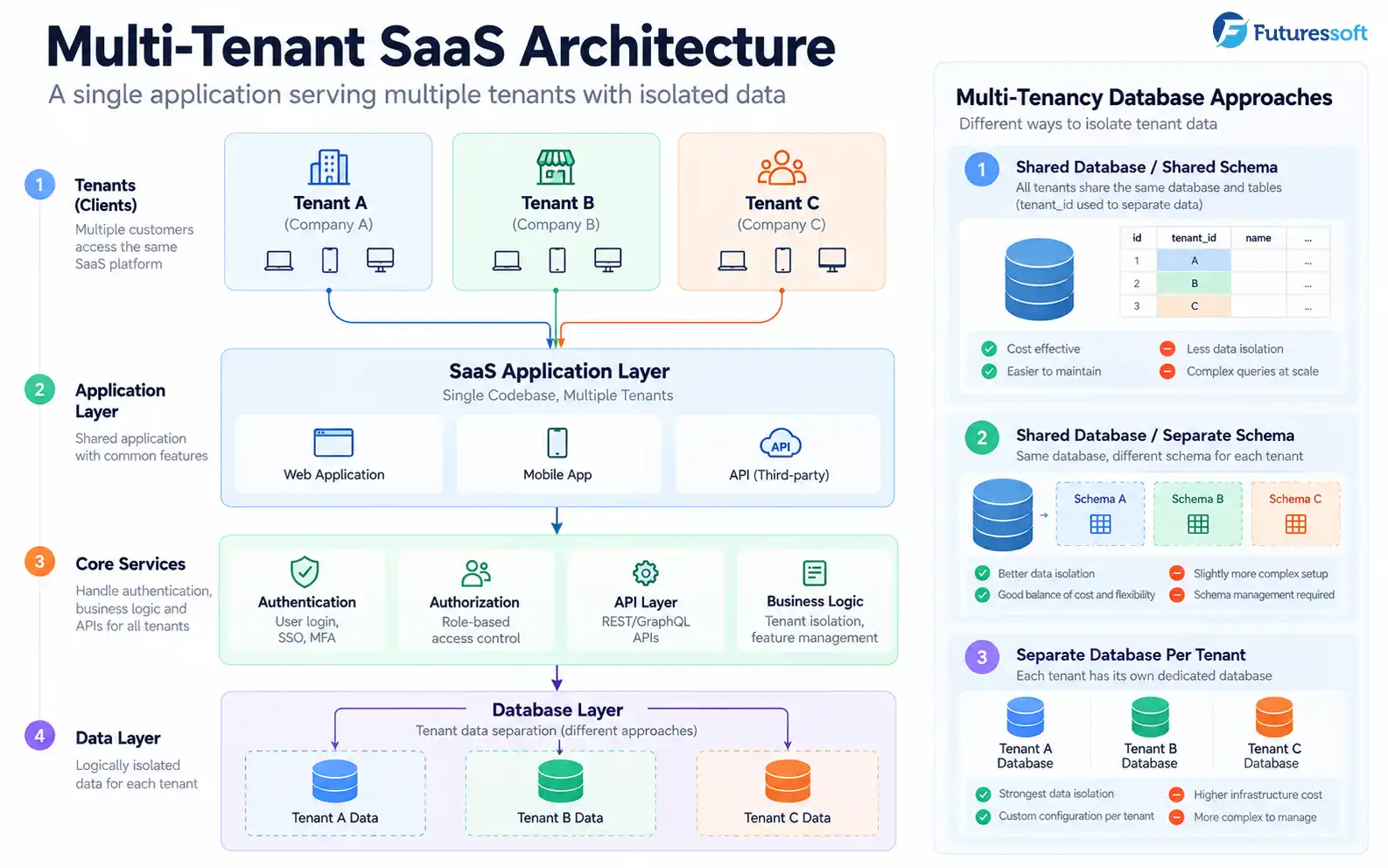
Multi-tenancy means one product serves multiple customers (tenants), and each tenant's data stays isolated from the others. Your school customer should never see another school's student records, even though both use the same software.
There are three common ways to do it:
|
Model |
How it works |
Best for |
|
Shared database, shared schema |
All tenants in the same tables, separated by a tenant ID |
Early-stage products, many small customers |
|
Shared database, separate schema |
One database, a separate schema per tenant |
Moderate isolation needs |
|
Separate database per tenant |
Each customer gets their own database |
Large customers, strict data requirements |
There's no single correct answer. Shared schemas are cheaper and simpler to maintain. Separate databases give stronger isolation but cost more to run and update. The mistake isn't picking the "wrong" model, it's not deciding early. Retrofitting multi-tenancy into a product that wasn't designed for it is one of the more painful rebuilds in SaaS.
How Much Does SaaS Development Cost in Nepal in 2026?
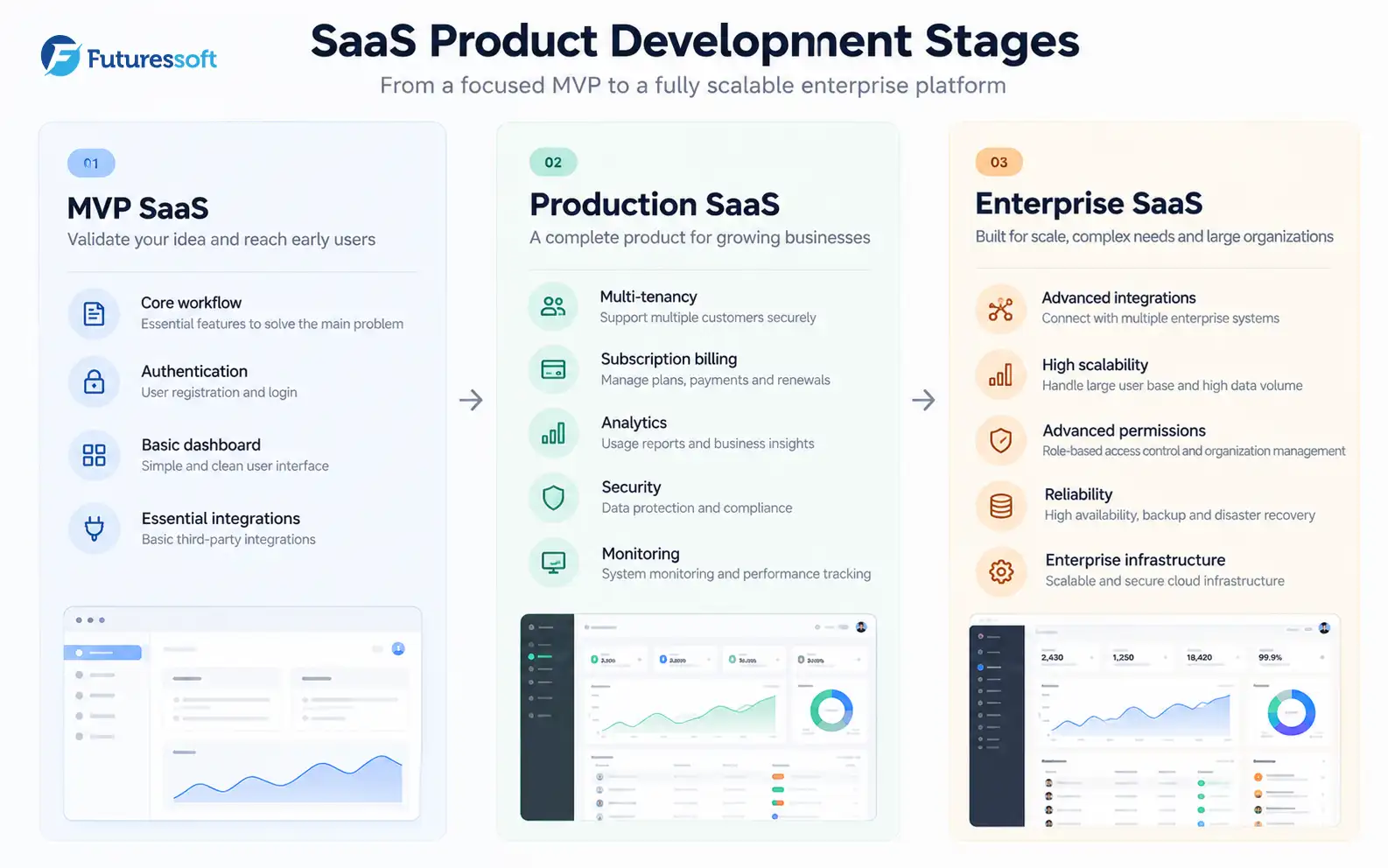
There's no honest single number. SaaS cost depends on scope, and anyone quoting a flat price without asking about your product is guessing. What helps more is understanding the stages:
|
Stage |
Typical scope |
Main cost drivers |
|
Prototype |
Core idea and primary workflow |
UX design, validation |
|
MVP |
Authentication, core workflow, dashboard, basic billing |
Features, roles, integrations |
|
Production SaaS |
Multi-tenancy, subscription billing, analytics |
Architecture, security, scale |
|
Enterprise SaaS |
Advanced integrations and infrastructure |
Compliance, reliability, scale |
What Actually Increases SaaS Development Cost?
-
Number of features: more screens and logic mean more build and test time.
-
User roles: each role adds permission rules to design and test.
-
Multi-tenancy: tenant isolation affects the whole database design.
-
Subscription billing: plans, upgrades, renewals, failed payments and invoices are bigger than they look.
-
Payment gateways: each one is a separate integration to build and maintain.
-
Third-party APIs: every external service adds a point that can fail.
-
Mobile apps: effectively a second product alongside the web version.
-
Real-time features: live updates and chat need different infrastructure.
-
Data migration: moving customers' existing records in cleanly is often underestimated.
-
Security requirements: deeper requirements mean more engineering.
-
Analytics: custom dashboards take more work than standard reports.
-
Cloud infrastructure: hosting, backups and monitoring are ongoing costs, not one-off.
For the general pricing method we use across projects, including how scope translates into budget, see our custom software development cost guide. The honest takeaway: cost follows scope, not the number of screens.
How Long Does It Take to Build a SaaS Product?
A narrowly scoped MVP and a mature multi-tenant platform are very different projects, so timeline should come from your requirements rather than a generic "X months."
The stages are consistent, though:
|
Phase |
What happens |
|
Discovery |
Business goals, users, requirements |
|
UX/UI and architecture |
User flows, prototypes, database and tenancy design |
|
MVP development |
Core product built in sprints |
|
Testing |
Functional, performance and security checks |
|
Launch |
Production deployment |
|
Iteration |
Customer feedback and new features |
Most delays come from scope growing mid-build, billing complexity and integrations, not from the interface. A short discovery phase up front is the most reliable way to get an estimate you can trust.
Best Technology Stack for SaaS Development in Nepal
No stack is "the best." The right one depends on your product, expected scale, integrations and who will maintain it. Here are the options we typically evaluate:
- Frontend: React or Next.js for responsive, fast interfaces
-
Backend: Laravel or Node.js, depending on the product and team
-
Database: PostgreSQL or MySQL, chosen around your data and tenancy model
-
Mobile: Flutter or React Native if you need a companion app
-
Infrastructure: AWS, Azure or Google Cloud for hosting, scaling and backups
-
DevOps: Docker, CI/CD pipelines, monitoring and automated backups
Our Cloud & DevOps services cover the infrastructure side. A sensible approach is to choose technology you can actually hire for and maintain, then scale it, rather than chasing whatever is trending.
Nepal-Specific SaaS Requirements
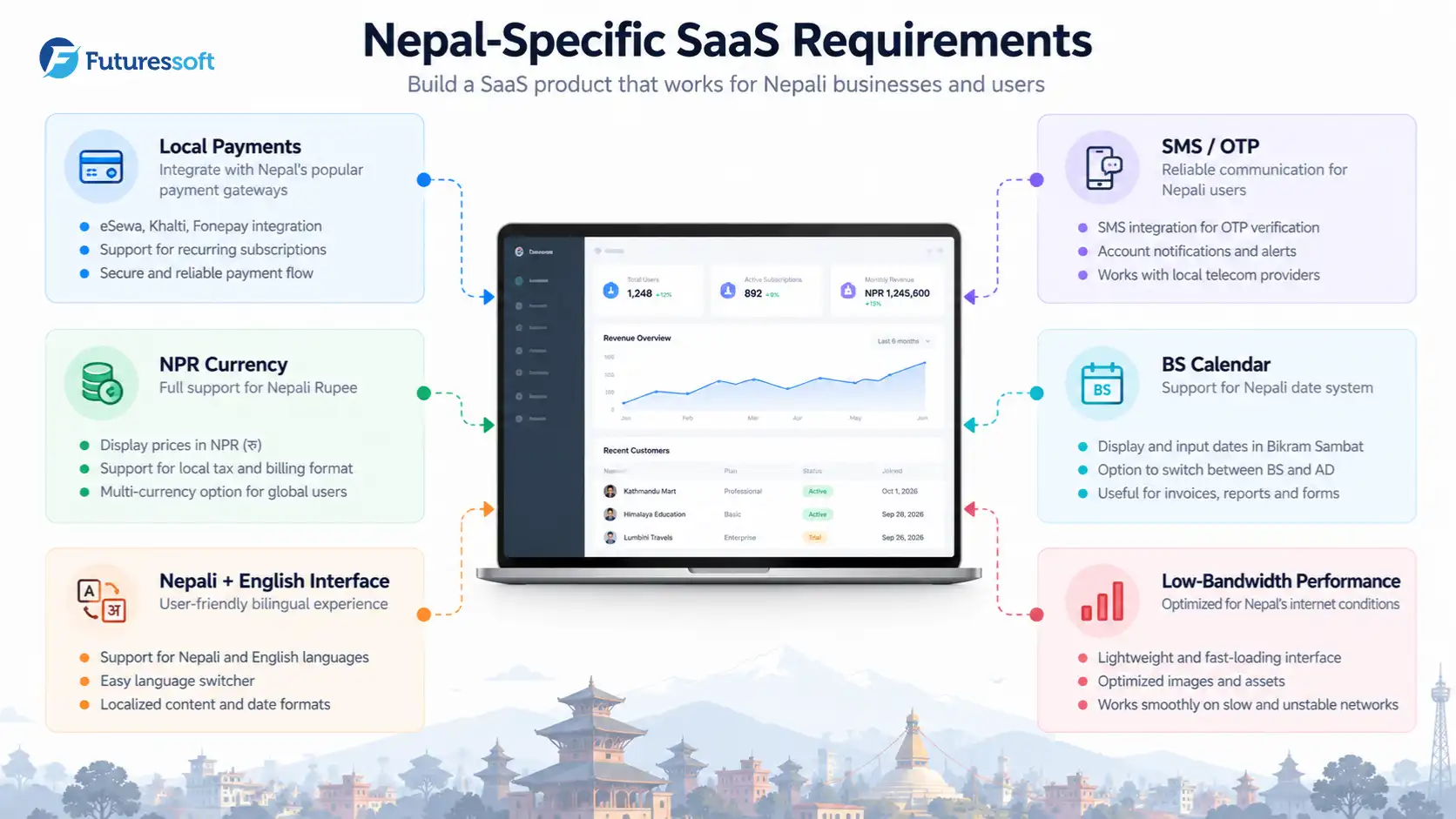
This is where generic international guides fall short. Depending on your audience, a SaaS product built for Nepal may need:
- Local payment options. Customers here commonly pay through wallets and bank-linked services such as eSewa, Khalti, Fonepay and connectIPS. You don't need all of them, so pick based on your users, and always confirm integration requirements in each provider's current documentation.
-
NPR support. Pricing, invoicing and reports in Nepali rupees, plus multi-currency if you sell internationally.
-
Nepali or bilingual interfaces where your users prefer them.
-
SMS and OTP. Still a dependable way to verify users and send alerts.
-
Bikram Sambat dates in products where records, fiscal years or reports use the Nepali calendar.
-
Low-bandwidth tolerance. Lightweight pages, sensible loading states and graceful handling of poor connections.
-
Local accounting and tax workflows, if your product touches invoicing. Rules change, so check the current requirements with the relevant government source before building them in.
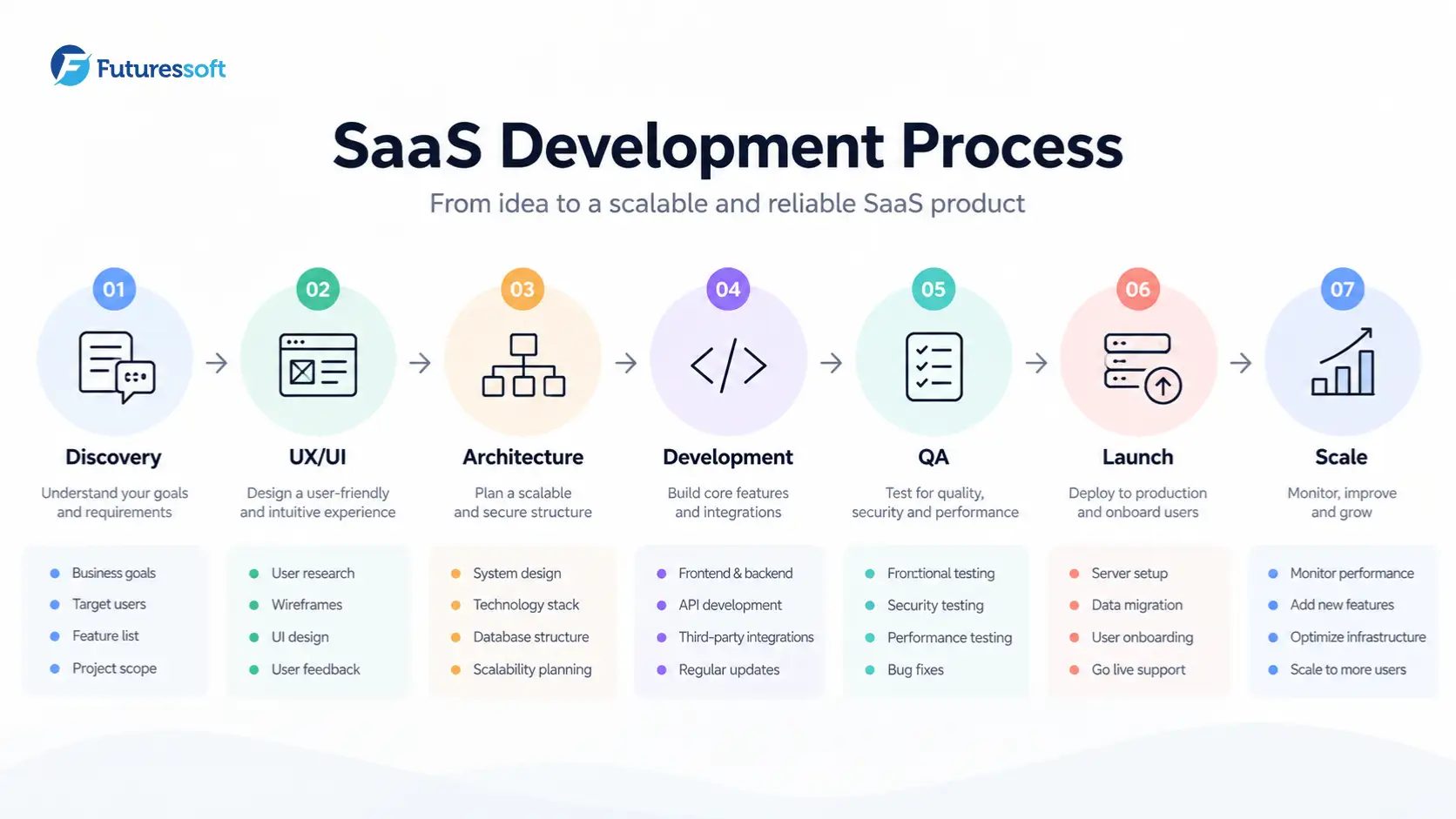
Our Software Delivery Process
SaaS follows the same disciplined delivery framework we use on every project, adapted for product work. You can see the full version on our process page.
- Discovery & Strategy. Stakeholder workshops, requirements gathering and technical assessment to define a clear roadmap.
-
UX/UI Design & Architecture. Wireframes, prototypes and architecture planning, including the tenancy model, before development begins.
-
Agile Development. Iterative sprints with code reviews and transparent progress tracking.
-
Quality Assurance & Security. Automated and manual testing for functionality, performance and security.
After launch, we continue with deployment support, monitoring and iteration, because a SaaS product is never really "finished."
Common SaaS Development Mistakes
-
Building too many features before validating. Launch the core, learn what customers use, then expand.
-
Leaving multi-tenancy for later. It touches everything, so it's far cheaper to design it from the start.
-
Underestimating billing. Renewals, failed payments, plan changes and invoices add up quickly.
-
Weak permission design. Retrofitting roles after launch is disruptive.
-
No analytics. If you can't see how customers use the product, you're guessing what to build next.
-
Ignoring data migration. Customers rarely start from zero; they bring spreadsheets.
-
Treating security as a final step. It belongs in the design, not last week.
-
A database that can't grow. Early shortcuts become expensive limits.
-
No maintenance plan. Updates, patches and monitoring are part of the product.
Build Custom SaaS or Use Existing Software?
|
Factor |
Existing platform |
Custom SaaS |
|
Initial cost |
Lower |
Higher |
|
Speed to start |
Faster |
Usually slower |
|
Customization |
Limited |
High |
|
Ownership |
Vendor-dependent |
Full control |
|
Unique workflows |
Limited |
Strong |
|
Scalability |
Depends on the product |
Depends on the architecture |
|
Integrations |
Vendor ecosystem |
Built around your needs |
Neither wins every time. If a ready-made tool already does 90% of what you need, use it. If your workflow is your competitive advantage, or you want to sell the software itself, custom is usually the better path.
How to Choose a SaaS Development Company in Nepal
Whoever you're evaluating, ask:
- Can they show real, verifiable production projects?
-
How would they design multi-tenancy for your product?
-
Who owns the source code and the data after delivery?
-
How is security handled, concretely?
-
What do deployment and DevOps look like?
-
What happens after launch, and how is maintenance priced?
-
Can they handle API and payment integrations?
-
How do they manage scope changes, because they will happen?
-
How is data migration handled?
A partner who asks about your customers and workflow before talking about technology is usually a good sign.
What We've Learned Building Business Systems
Across the platforms and business systems we've built, a few patterns repeat, and they apply directly to SaaS:
- Requirements change once real users arrive. Plan for iteration, not a perfect first version.
-
Integrations take more time than interfaces. Payments, SMS and third-party APIs are where the engineering effort goes.
-
Permissions need planning early. Role design is much cheaper at the start.
-
Reporting should shape the database, not the other way round.
-
Data migration is almost always underestimated.
-
Mobile access is wanted sooner than expected.
-
Maintenance should be planned before launch, not after something breaks.
Why Businesses Choose Futuressoft for SaaS Development
Futuressoft is a software development company in Nepal working across custom software, web applications, mobile apps, cloud and DevOps, and enterprise CMS platforms. For SaaS, that means one team covering the product, the backend, the integrations and the infrastructure it runs on.
We apply a discovery-first process, build for scale from the architecture stage, and have delivered high-traffic production platforms for clients including Ratopati, Ajakoartha, Prades Khabar and Global Aawaj. You can explore the details in our case studies and portfolio. Our enterprise CMS work for media companies is a good example of the kind of scalable backend thinking SaaS needs, and our news portal cost guide shows how we explain scope-based pricing.
Planning a SaaS product? Start with a conversation about your customers and workflow before choosing a technology. Schedule a call and we'll help you scope an MVP that fits your goals.
Frequently Asked Questions
What is SaaS development?
SaaS development is building software that customers use online, usually by subscription, with the provider handling hosting and updates. It includes the product, user accounts, billing and the infrastructure that serves many customers at once.
How much does SaaS development cost in Nepal?
It depends on scope: features, user roles, tenancy model, billing, integrations and security. Projects generally fall into prototype, MVP, production and enterprise stages rather than one fixed price. Our cost guide explains the method.
How much does it cost to build a SaaS MVP?
An MVP costs less than a full platform because it covers only login, the core workflow, a basic dashboard and simple billing. The final figure depends on how many roles, integrations and payment options you include.
How long does it take to build a SaaS product?
It varies with scope. A narrow MVP moves much faster than a multi-tenant platform with several integrations. A discovery phase gives you a realistic estimate for your specific product.
What technology is used to build SaaS applications?
Common choices include React or Next.js on the frontend, Laravel or Node.js on the backend, PostgreSQL or MySQL for data, and AWS, Azure or Google Cloud for hosting. The right stack depends on your product and team.
What is multi-tenant SaaS architecture?
It's a design where one application serves many customers while keeping each customer's data separate. It can use a shared schema, separate schemas or separate databases, depending on isolation and cost needs.
Can a SaaS product integrate with eSewa or Khalti?
Yes, SaaS products can integrate with local payment services such as eSewa, Khalti, Fonepay and connectIPS. Which ones you need depends on your customers, and each has its own requirements to confirm.
Can a SaaS product have both web and mobile apps?
Yes. Many start with a web app and add a mobile companion later. A mobile app is effectively a second product, so plan its scope and budget separately.
What is the difference between SaaS and custom software?
Custom software is usually built for one organization. SaaS is built to serve many customers on subscription from a shared platform, which adds multi-tenancy, billing and customer-level data isolation.
Can Futuressoft build a SaaS platform?
Yes. Futuressoft builds scalable web platforms, backend systems and integrations, and can scope a SaaS product from discovery through launch. Share your requirements for a project-specific recommendation.
How do I choose a SaaS development company in Nepal?
Look for verifiable production work, a clear approach to multi-tenancy and security, code ownership, post-launch support and a transparent way of handling scope changes.
Does a SaaS product need ongoing maintenance?
Yes. Security patches, bug fixes, monitoring and new features continue after launch. A maintenance plan should be part of the original scope.
Related Insights