News Portal SEO in Nepal: Checklist for 2026

A news portal can publish brilliant reporting and still be invisible on Google. It usually isn’t about the writing. It’s about whether search engines can find each story, understand it, and trust the site behind it, quickly, dozens of times a day.
That is what news portal SEO is: the technical setup, article-level habits and publishing processes that help search engines discover, index and surface your stories. It overlaps with ordinary website SEO, but news sites play a harder game. You publish constantly, your best content gets stale in hours, and traffic arrives in violent spikes rather than a steady trickle.
This guide is a hands-on checklist for Nepali publishers, editors and anyone planning to launch or rebuild a news portal. It’s based on Google’s own published guidance and on what we see when building high-traffic media platforms at Futuressoft. Where something is a judgment call, we say so. Where nobody can promise a result, we say that too.
In this guide
- Why news SEO is different
-
The technical foundation
-
On-page checklist for every article
-
NewsArticle schema
-
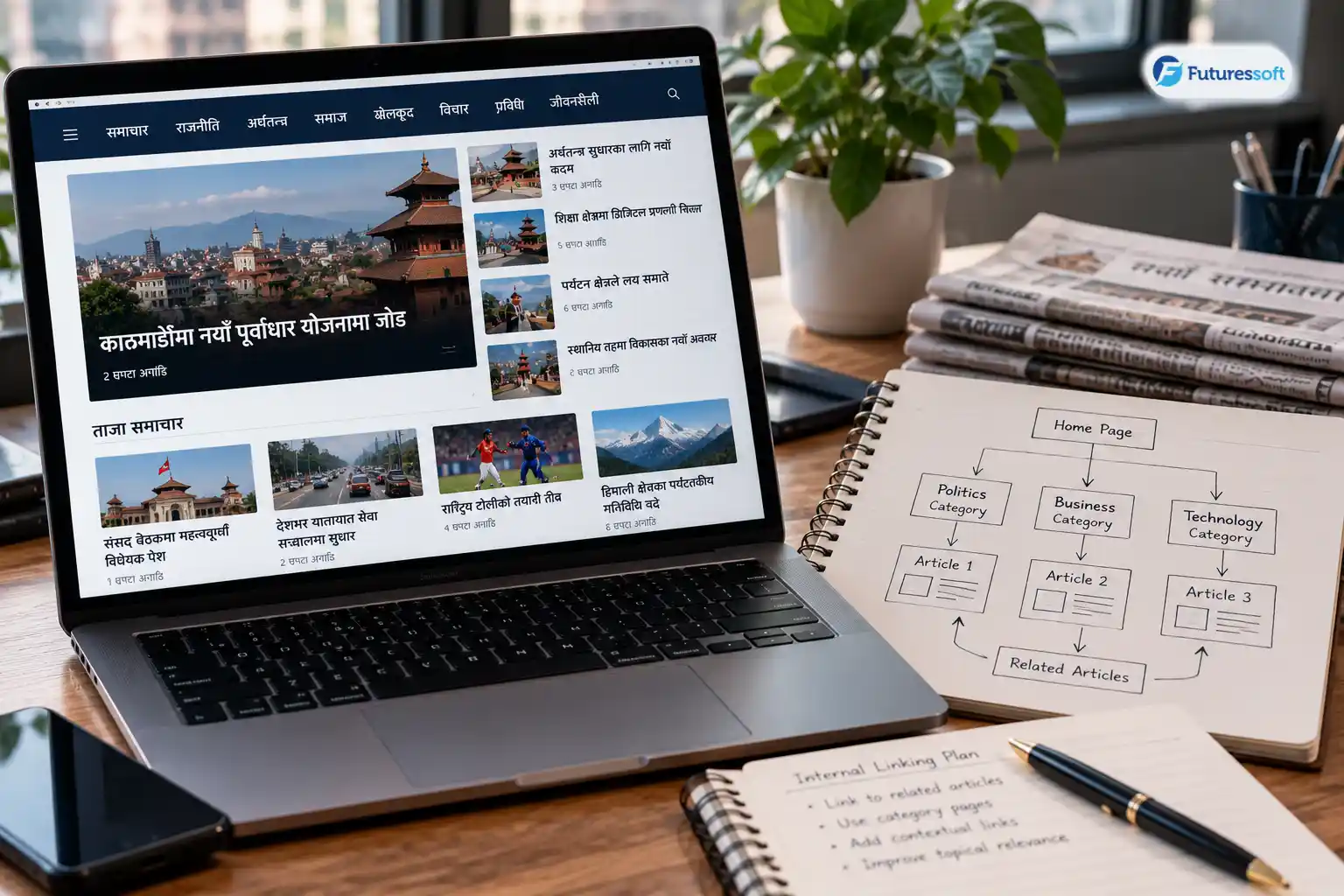
Internal linking
-
Speed and Core Web Vitals
-
Google News eligibility
-
AI search (AI Overviews and AI Mode)
-
Nepali and English content
-
The audit checklist and FAQs
Why News Portal SEO Is Different From Regular Website SEO
A company website might add two pages a month. A news portal adds that many in an hour. That changes almost everything:
- Volume. Thousands of URLs, many of them near-duplicates (category pages, tag pages, paginated archives).
-
Freshness. A story’s search value can peak within hours, so a slow discovery process costs you real traffic.
-
Long tail. Your archive still matters. A good explainer from 2024 can keep bringing readers if it stays linked and crawlable.
-
Accuracy. Publication dates, bylines and corrections are part of how your site earns trust, not afterthoughts.
-
Spikes. An election, a budget day or a disaster can multiply traffic overnight. If your pages crawl or load badly under pressure, you lose both readers and search visibility.
In short: a regular site is optimized once and maintained. A news portal is optimized every day, by the people writing and publishing, and by the system underneath them.
The Technical Foundation Every News Website Needs
If search engines can’t reach your articles, nothing else in this guide matters. Start here.
Make every important article crawlable and indexable
Google discovers pages mainly by following links. Make sure your articles are reachable through plain HTML links (a real <a href>), not only through buttons, infinite scroll or search boxes that need JavaScript to reveal results.
Check three things on a sample of recent articles:
- The article text is in the page’s HTML, not injected late by a script.
-
Nothing is accidentally blocked by robots.txt or a stray noindex tag.
-
Each article has a single, self-referencing canonical URL, so print versions, AMP leftovers, tracking parameters and mobile subdomains don’t compete with it.
Use permanent, descriptive article URLs
A good article URL is readable, stable and unique, something like /politics/budget-2083-explained. Two mistakes cause real damage:
- Putting the date or a changing section name in a way that rewrites the URL when an editor changes the category.
-
Changing URLs without a permanent (301) redirect. Every inbound link and every bit of search history attached to the old address is lost.
If your CMS regenerates the URL whenever the headline is edited, fix that. Corrections to a headline shouldn’t break a story’s address.

Set up XML and Google News sitemaps
A standard XML sitemap lists the URLs you want indexed and helps search engines find content that internal links might miss. A Google News sitemap is a more focused file for recent articles. Google’s documentation says it should only include articles published in roughly the last two days, with a cap of 1,000 URLs per file, so it has to be generated dynamically and old entries must drop off automatically.
One honest caveat: a sitemap helps discovery. It doesn’t guarantee indexing, and submitting one isn’t a ranking trick. If a page is low quality, blocked or a duplicate, the sitemap won’t rescue it. Google’s news sitemap guide lays out the exact format.
Check what Google actually sees in Search Console
Don’t guess. Open Google Search Console and use:
- URL Inspection on a few fresh articles to see whether they’re indexed and which canonical Google chose.
-
Page indexing report to see why URLs are excluded. “Crawled, currently not indexed” or “Duplicate without user-selected canonical” on article pages are early warnings.
-
Performance report filtered to your news section, to see which queries really bring readers in.
Make this a weekly habit. Most indexing problems on news sites are quiet, and they’re only found by looking.
On-Page SEO Checklist for Individual News Articles
Good article SEO is mostly good journalism, expressed clearly. You don’t need keyword-density formulas. You need the page to say plainly what the story is about.
Write accurate, descriptive headlines
Put the real subject and the key names in the headline: who, what, where. A headline that tells readers what happened will usually serve search better than a vague teaser. Avoid exaggeration; clickbait that doesn’t match the story hurts trust and engagement.
Answer the central question in the opening paragraph
The first paragraph should make the people, organizations, place and event clear. Readers get what they came for, and search systems (including AI-driven ones) can understand the page without guessing.
Show real bylines and clear dates
Use genuine author names linked to author pages with a short bio. Show the original publication date, and show an update date only when the story was meaningfully updated. Don’t refresh dates just to look new; it undermines the credibility you’re trying to build.
Optimize images properly
Use descriptive file names and honest alt text, compress images, serve sensible dimensions and lazy-load anything below the fold. In Nepal's mobile-heavy audience, an oversized hero image is one of the most common reasons an article feels slow.
Link to background and sources
Point readers to earlier coverage and to original sources: official documents, statements, data. That helps readers, shows your work and gives search engines context for how stories relate.
NewsArticle Schema Markup: What Publishers Should Implement
Structured data is a machine-readable summary of what’s on the page. For news articles, the relevant type is NewsArticle (Google also supports Article and BlogPosting). The useful properties include:
- Headline and one or more images
-
Author name and a link to the author’s profile page
-
Date published and date modified
-
Publisher name and logo
The rule that matters most: the markup must match what visitors actually see. Don’t mark up an author who isn’t shown or dates that differ from the page. Google’s Article structured data documentation lists the recommended properties, and you can check your pages with its Rich Results Test.
Two more honest points. Schema isn’t a ranking guarantee, and Google doesn’t require NewsArticle markup for its news features. It simply helps Google understand the page accurately, which is worth doing, especially if your CMS can generate it automatically for every article rather than relying on editors to remember.
Internal Linking for News Portals
Internal links are how authority and discovery flow through a large site. On news portals they’re often neglected because editors are busy, which is exactly why they should be built into the CMS.
Connect these things deliberately:
- Permanent category and topic pages that stay stable and link to the best, latest and most important stories.
-
New articles to earlier coverage of the same story or issue.
-
Breaking news to background explainers, so readers (and crawlers) get context.
-
Author pages to their articles, and articles back to their authors.
-
Evergreen stories to new coverage, so a strong older piece keeps earning traffic.
Here’s a simple example, using a hypothetical budget story:
- The Economy category page links to today’s article, Budget 2083: What Changes for Small Businesses.
-
That article links to last year’s explainer on how Nepal’s budget process works, and to your earlier piece on tax changes.
-
The explainer links forward to the new article in a “related coverage” box, so authority and readers flow both ways.
Also review your tag archives. If your site generates hundreds of thin pages with one or two articles each, they dilute your site rather than strengthen it. Keep tags that serve readers and consider consolidating or noindexing the rest, after checking they don’t earn traffic first.
If you’re deciding how a CMS should handle categories, related-article modules and breadcrumbs, our guide to enterprise CMS development for media companies goes deeper on the architecture side.

News Website Speed and Core Web Vitals
Speed is part of search performance and, more importantly, reader behavior. Google measures real-user experience with Core Web Vitals. The commonly cited “good” thresholds, measured at the 75th percentile of visits, are:
- Largest Contentful Paint (LCP): 2.5 seconds or less
-
Interaction to Next Paint (INP): 200 milliseconds or less
-
Cumulative Layout Shift (CLS): 0.1 or less
On news sites the usual culprits are consistent: heavy images, too many ad and tracking scripts, layout shifts caused by late-loading ad slots, plugin-heavy themes and slow database queries on archive-heavy pages.
What tends to work:
- Compress and properly size images, and lazy-load below the fold.
-
Cache aggressively, at the server, application and edge layers.
-
Serve static assets through a CDN so readers across Nepal and the diaspora load pages from nearby.
-
Reserve space for ads so the page doesn’t jump as they load.
-
Load third-party scripts sparingly and defer what isn’t essential.
-
Watch real-user data (Search Console’s Core Web Vitals report), not just a lab test on your office Wi-Fi.
The bigger point is to plan for your worst day, not your average one. A site that is fine at 5,000 readers can fall over at 500,000 during a major event. In our Ratopati case study, the platform was built on Laravel, MongoDB and Redis with CDN delivery precisely because news traffic is unpredictable, and the write-up reports 95% faster content delivery and 99.9% historical uptime from that caching-first approach. The same principle shows up in our Ajakoartha case study: scale is easier to design in than to bolt on later.
For a plain-language look at what caching, search and CDN decisions cost, see our news portal development cost guide.
How to Improve Google News Discovery
There’s an important distinction here: being eligible to appear in Google’s news experiences is not the same as being shown there. Google’s systems automatically consider content that meets its policies, and inclusion is never guaranteed. Google has also said publishers no longer need to register through Publisher Center just to be considered, though it remains useful for managing how your publication appears.
What you can control:
- Transparency. Show who you are: a clear About page, contact details, editorial team and author bylines.
-
Original, useful reporting rather than rewritten wire copy.
-
Accurate headlines and clearly visible publication dates.
-
Stable section URLs and permanent article URLs, reachable by crawlable links.
-
Clean sitemap setup, including a news sitemap where it makes sense.
None of this is a secret formula. It’s the same trust-and-clarity groundwork good newsrooms already value, made visible to search engines.
Preparing Your News Portal for AI Overviews and AI Mode
Everyone is asking how to “rank in AI search.” The honest answer is less exciting than the hype. Google’s published guidance for its AI features says they build on the same foundational SEO principles, and that no special AI markup, file or separate technique is required. Following best practices still doesn’t guarantee that you’ll be selected or cited. You can read it in Google’s AI features guidance.
So what’s actually worth doing?
- Answer the main question early, in plain language, near the top.
-
Use descriptive headings for related questions the story raises.
-
Use consistent names for people, places and organizations (decide on one English spelling and stick with it).
-
Cite original sources: official documents, statements, data.
-
Keep important content as real text, not locked inside images or video.
-
Keep pages crawlable and well linked, as covered above.
-
Add something original: your own reporting, data or analysis that a summary can’t replace.
We’d skip anything that promises “GEO hacks” or tells you to add special files for AI. Strong fundamentals and genuinely useful reporting are the more defensible bet.
Nepali and English Content: Language and URL Considerations
Most Nepali publishers run more than one language, and this is where small technical choices cause big headaches.
- Use Unicode, not legacy fonts. Text typed in non-Unicode fonts (such as Preeti-style encodings) looks fine on screen but is gibberish to search engines. If any of your Nepali content is stored that way, convert it.
-
Give each language version its own URL. Separate, clearly structured URLs for Nepali and English versions are easier to crawl and index than content switched by cookies or scripts.
-
Be careful with automatic language redirects. Forcing visitors (or crawlers) to a version based on location or browser settings can stop them from reaching the page they wanted.
-
Keep metadata in the right language, with accurate titles and descriptions for each version.
-
Test on mobile. Devanagari text needs a readable font size and line height on small screens, and many of your readers are on phones with variable connections.
A provincial or regional publisher faces the same questions at a smaller scale, and the rewards are real. Our Pradesh Khabar case study looks at what a provincial news ecosystem needs from its platform.
A Practical News Portal SEO Audit Checklist
Use this as a quarterly audit, or hand it to your developer.
|
Audit area |
What to verify |
|
Crawling |
Important articles are reachable through crawlable internal links |
|
Indexing |
Canonicals, robots directives and indexing status are correct |
|
URLs |
Article URLs are unique, readable and permanent |
|
Sitemaps |
XML sitemap and (where used) news sitemap are accurate and current |
|
On-page SEO |
Headlines, intros and metadata describe the story honestly |
|
Structured data |
Article markup matches visible content |
|
Internal links |
Articles connect to relevant categories, topics and older coverage |
|
Performance |
Core Web Vitals are checked on real mobile data |
|
Transparency |
Publisher, author and publication details are clear |
|
Languages |
Nepali text is Unicode; language versions have separate URLs |
|
AI search readiness |
Content is accessible, well structured and genuinely useful |
When It’s Time to Get Technical Help
Many of the fixes above are editorial habits any newsroom can adopt. Others live in the platform: URL handling, caching, sitemap generation, schema output, search. If your CMS fights you on these, the problem is architecture, not effort.
That’s the work we do. Futuressoft builds custom news portals and CMS platforms for Nepali media organizations; you can see the range in our portfolio, or read about our custom CMS and software services. If you’d like a second pair of eyes on your current setup, talk to us about your news portal’s technical requirements.
Frequently Asked Questions
How do I optimize a news portal for Google?
Make sure every article is crawlable, indexable and has a permanent URL. Add accurate headlines, real bylines and dates, a clean sitemap, matching article schema and fast mobile pages. Then monitor Search Console regularly. Strong, original reporting does the rest; nothing here guarantees a specific ranking.
How long does it take for Google to index a news article?
There’s no fixed time. Well-linked articles on established, frequently crawled sites are often found quickly, while new or poorly linked pages can take longer. Use URL Inspection to check status, keep internal links and sitemaps clean, and don’t assume same-day indexing.
Does a news website need a Google News sitemap?
Not strictly, but it can help Google discover recent articles faster, especially on busy sites. It should list only recent stories and be generated automatically. A regular XML sitemap and strong internal linking remain important either way.
Is the NewsArticle schema required to appear in Google News?
No. Google doesn’t require NewsArticle markup for its news features. It’s still worth adding, because it helps Google understand your headline, author, images and dates, provided the markup matches what visitors see on the page.
How can a news portal become eligible for Google AI Overviews?
There’s no special switch. Pages need to be indexed and eligible to show in Google Search with a snippet. Google’s guidance says normal SEO best practices apply: helpful, original, crawlable content. Selection and citation can’t be guaranteed.
Can poor website speed affect a news portal’s search performance?
Yes. Core Web Vitals are part of Google’s page experience signals, and slow pages also lose readers, which hurts engagement and ad revenue. Speed alone won’t outrank great content, but a consistently slow site makes everything else harder.
Related Insights