Mobile App Development in Nepal 2026
Most businesses in Nepal don't start out thinking "we need a mobile app." It usually starts as a smaller, more specific frustration: customers messaging on Facebook to ask if something is in stock, a delivery team coordinating over phone calls because there's no way to track orders in real time, or a booking process that only works if someone is manually checking a spreadsheet. A website answers some of that. A mobile app answers the part that a website can't: something a customer opens every day, that works on a slow connection, that sends a notification instead of waiting for someone to check email.
This guide covers what mobile app development actually looks like in Nepal in 2026, what it costs, how long it takes, Android vs iOS, Flutter vs React Native, the features that actually matter, and how to tell a capable development partner from a risky one.
What Is Mobile App Development, Really?
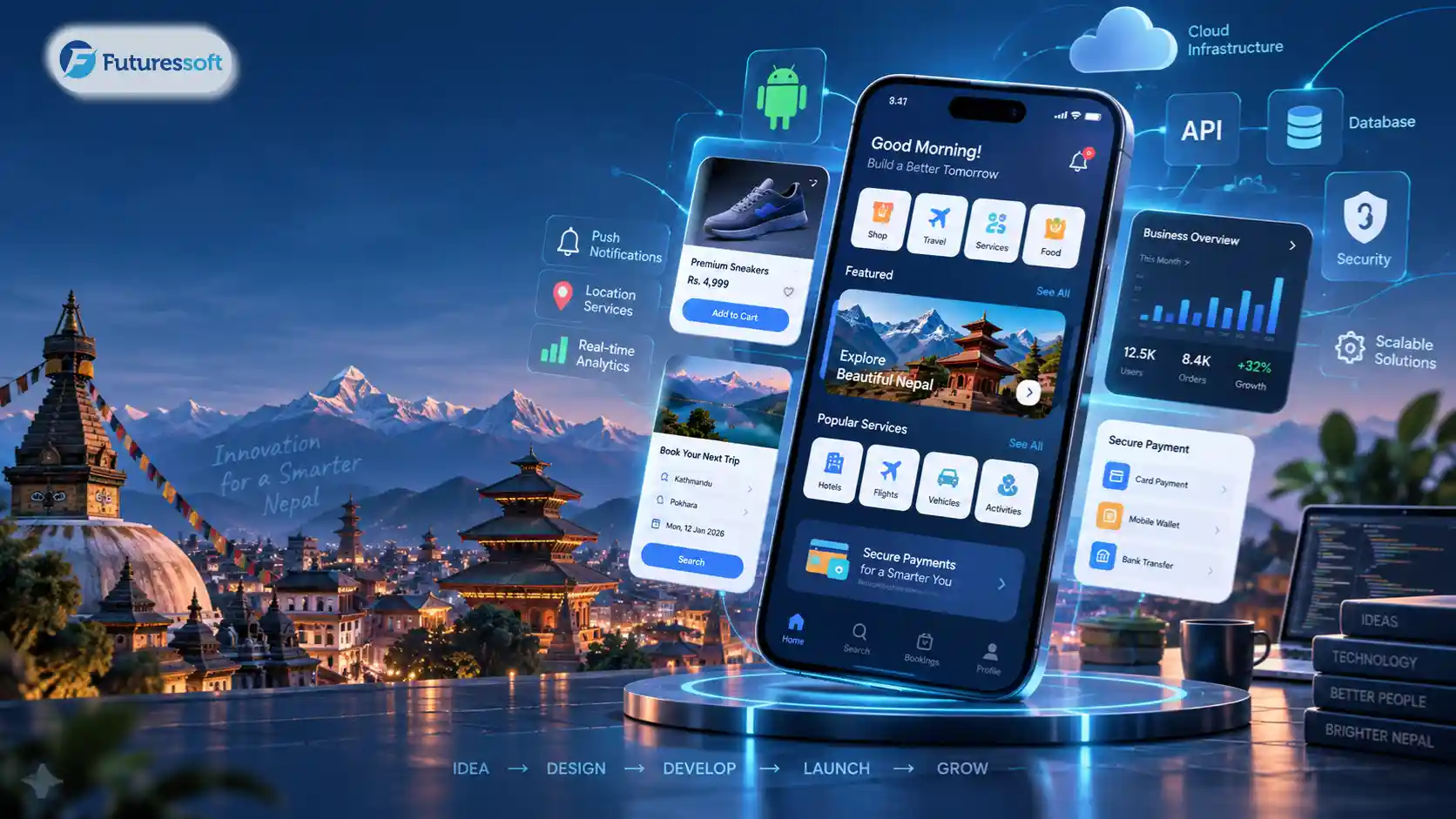
A mobile app isn't just a smaller version of a website. Underneath the screens a user taps through, a properly built app usually involves several distinct layers working together:
- Native or cross-platform frontend the actual iOS/Android interface, built with Swift, Kotlin, Flutter, or React Native
-
Backend & APIs the server-side logic that handles what happens when a user places an order, logs in, or sends a message
-
Database where user accounts, orders, and business data actually live
-
Admin dashboard a web-based panel for the business to manage users, content, and orders without touching code
-
Third-party integrations payment gateways, SMS/OTP, maps, push notifications, analytics
-
Deployment & app store compliance getting the app approved and published on the Google Play Store and Apple App Store
-
Maintenance keeping the app working as OS versions, devices, and security requirements change over time
A business owner doesn't need to understand every layer in technical detail. What matters is what the app actually lets people do: order something, track something, book something, pay for something reliably, on a phone, without someone on the other end manually fixing it afterward.
How Much Does Mobile App Development Cost in Nepal in 2026?
This is usually the first question, and the honest answer is that a "mobile app" isn't a single product with a single price. Two apps that sound similar on a client call "an app for my business" can differ enormously once you look at what's actually inside them: how many user roles, how much backend logic, how many integrations, how much custom design.
Instead of a single number, it's more useful to think in planning tiers:
|
App Category |
Typical Scope |
Planning Level |
|
Basic / MVP |
Login, a handful of core screens, limited backend |
Lower |
|
Business app |
User accounts, backend, notifications, one or two integrations |
Medium |
|
E-commerce / booking app |
Payments, product/service catalogue, order or booking management, admin panel |
Medium–High |
|
Marketplace / on-demand app |
Multiple user types (customer, vendor, rider), real-time tracking or matching |
High |
|
Enterprise app |
Advanced security, multiple integrations, analytics, large-scale infrastructure |
Custom |
Published pricing guides for Nepal's app development market vary widely from a relatively small budget for a simple MVP to a much larger investment for a complex, multi-role platform which is exactly why treating any published number as a fixed quote is misleading. The tables above are planning benchmarks, not pricing. A proper quote should come from a scoped discovery conversation about your actual workflow, not a generic price list. For the same reasoning applied more broadly across software projects, see our breakdown in Custom Software Development Cost in Nepal 2026.
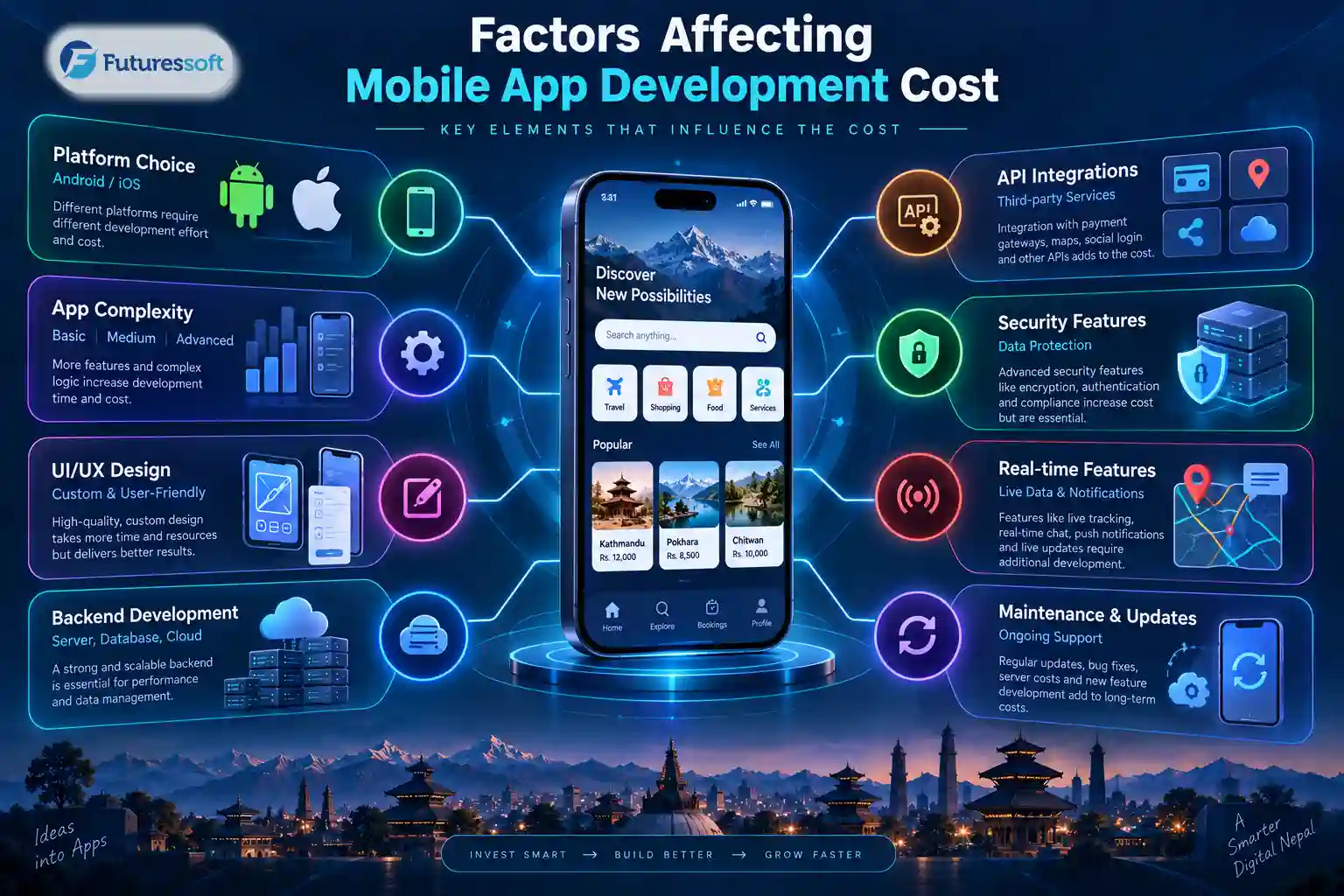
What Factors Actually Affect Mobile App Development Cost?
Number of platforms. Building for Android only, iOS only, or both changes both cost and timeline cross-platform frameworks narrow this gap but don't eliminate it entirely.
App complexity. A simple form-and-list app costs far less than one with real-time tracking, matching algorithms, or complex business rules.
UI/UX design. A templated interface is cheaper than a fully custom, brand-specific product design with original screens and motion.
Backend development. APIs, databases, authentication, and admin dashboards are usually a bigger share of the budget than the visible app screens.
Third-party integrations. Payment gateways, maps, SMS/OTP, analytics, CRM, and accounting-system connections each add scope.
Security requirements. Authentication, authorization, encryption, and audit logging matter more for apps handling payments or sensitive data.
Real-time functionality. Chat, live GPS tracking, and live order/ride status require different (and more expensive) architecture than static content.
Maintenance and future development. OS updates, security patching, performance tuning, and new features are an ongoing cost, not a one-time one.
What Should a Mobile App Built for Nepal Actually Support?
A generic "build us an app" brief misses a lot of what actually matters for the Nepali market. A few things worth planning around from day one:
- Android-first thinking. Android has the largest installed base in Nepal, and device diversity is wide from flagship phones to lower-spec, budget Android devices so performance on modest hardware matters more than it does in markets dominated by high-end devices.
-
Variable network conditions. Not every user is on fast 4G/5G everywhere, all the time. Apps that degrade gracefully on slower connections caching, offline states, lightweight assets perform noticeably better in real usage.
-
Local payment gateways. Integration with Nepal's common digital wallets and payment gateways (eSewa, Khalti, and similar providers) is usually a core requirement, not a nice-to-have, for any commercial app.
-
SMS/OTP verification. Phone-based verification is still the default trust mechanism for most consumer apps in Nepal.
-
Nepali and English language support. Bilingual interfaces widen who can actually use the app comfortably.
-
Push notifications. For repeat engagement order updates, booking reminders, offers done carefully so users don't disable them.
For context on the market this app will be used in: Nepal had roughly 16.6 million internet users at an online penetration rate of about 56% by the end of 2025, alongside 32.4 million active cellular mobile connections, according to DataReportal's Digital 2026 Nepal report. The gap between those two figures is worth noting on its own a large share of active mobile connections in Nepal are still used mainly for voice and SMS rather than mobile data, which is one more reason a mobile app shouldn't assume every user has a fast, always-on connection.
Android vs iOS: Which Should You Build First?
|
Factor |
Android |
iOS |
|
Reach in Nepal |
Broader installed base |
Smaller but present, especially among premium/urban and diaspora users |
|
Device diversity |
High many manufacturers and price points |
Lower a controlled hardware ecosystem |
|
Development & testing |
Wider range of screen sizes and OS versions to test against |
More predictable hardware, fewer device variations |
|
Typical use case |
Mass-market consumer apps, delivery, local services |
Premium products, international audiences, NRN-focused apps |
|
Best choice |
Depends on your specific target users |
Depends on your specific target users |
There's no universal right answer here; it genuinely depends on who your users are. A local delivery or booking app aimed at price-sensitive consumers across Nepal will usually prioritize Android first. A product targeting international clients, a premium urban audience, or the Nepali diaspora may see iOS pull more weight than the national averages suggest. Many businesses eventually need both; the question is which one earns the first release.
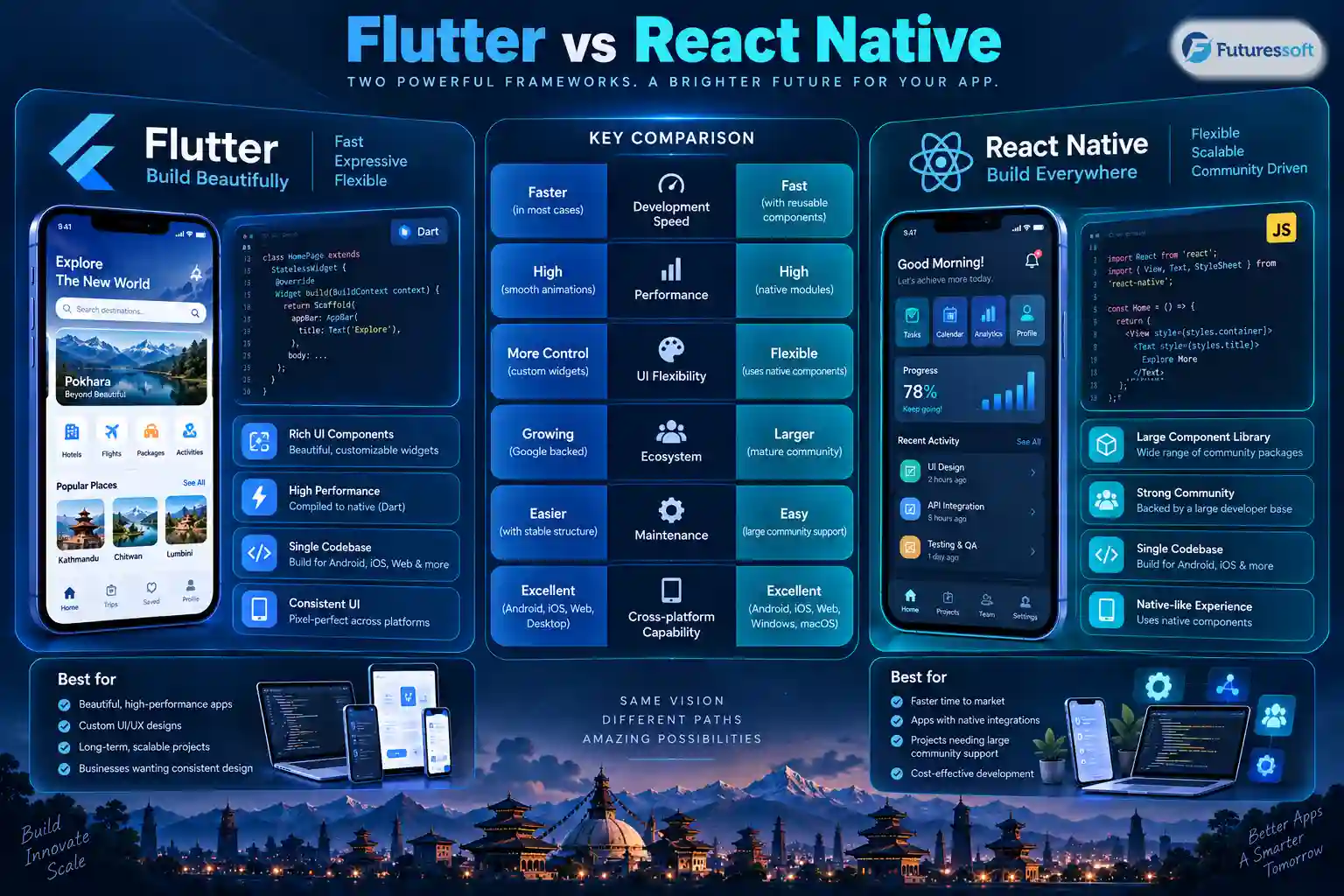
Flutter vs React Native for App Development in Nepal
Cross-platform frameworks let a single codebase power both Android and iOS apps, which is often the right call for businesses that need to move faster or manage a tighter budget without sacrificing native performance. Futuressoft builds with both Flutter and React Native, chosen based on the project rather than a default preference.
|
Factor |
Flutter |
React Native |
|
Code sharing across platforms |
Strong |
Strong |
|
UI control & custom design |
Strong renders its own UI layer |
Strong closer to native components |
|
Ecosystem |
Dart / Flutter |
JavaScript / React |
|
Performance |
Near-native for most use cases |
Near-native for most use cases |
|
Best fit |
Products where a highly custom, consistent UI matters |
Teams already working in the React/JavaScript ecosystem |
|
Cost |
Scope-dependent |
Scope-dependent |
Neither framework is categorically cheaper or "always better" claims like that don't hold up once you look at a real project's requirements. The right choice depends on your app's design needs, your team's existing skills if you plan to maintain it in-house later, and what the backend and integrations look like. This is a discovery-stage decision, not a default setting.
Types of Mobile Apps Businesses in Nepal Are Building
The same core engineering approach adapts across very different use cases:
- E-commerce apps product catalogues, cart, checkout, order tracking
-
Booking and reservation apps availability, confirmations, payment collection
-
Education apps courses, attendance, results, parent communication
-
Finance and business apps accounts, transactions, reporting, approvals
-
Delivery and on-demand apps real-time tracking, dispatch, multiple user roles
-
Travel apps itineraries, bookings, notifications for travelers on the move
-
Healthcare apps appointment scheduling, patient records, reminders
-
Internal business apps field staff tools, inventory checks, internal approvals
-
SaaS companion apps a mobile layer on top of an existing web platform
If your business already has (or is planning) a web platform behind one of these use cases, it's worth reading how the same system looks on the web side in Web Application Development in Nepal 2026 a mobile app and a web application often end up sharing the same backend and business logic.
Essential Features of a Modern Mobile App
Most well-built apps, regardless of industry, share a common feature foundation:
|
Feature |
Purpose |
|
User registration & login |
Secure, simple onboarding |
|
Role-based access |
Different views for customers, staff, admins |
|
User profiles |
Personalization and order/booking history |
|
Push notifications |
Re-engagement and timely updates |
|
Search & filtering |
Finding what the user actually wants, fast |
|
Payment integration |
eSewa, Khalti, cards, or other local gateways |
|
GPS/location |
Delivery tracking, nearby search, location-based services |
|
In-app chat |
Support or user-to-user communication |
|
Analytics |
Understanding real usage, not guesses |
|
Admin dashboard |
Managing users, orders, and content from the web |
|
API integrations |
Connecting to payment, SMS, CRM, or accounting systems |
|
Offline / poor-connectivity handling |
Caching and graceful degradation on weak networks |
|
App update mechanism |
Rolling out fixes and new features without friction |
Not every app needs all of these at launch. Part of a proper discovery phase is deciding what belongs in version one and what can be phased in later; a smaller, focused app that actually ships beats a feature-heavy one that never does.
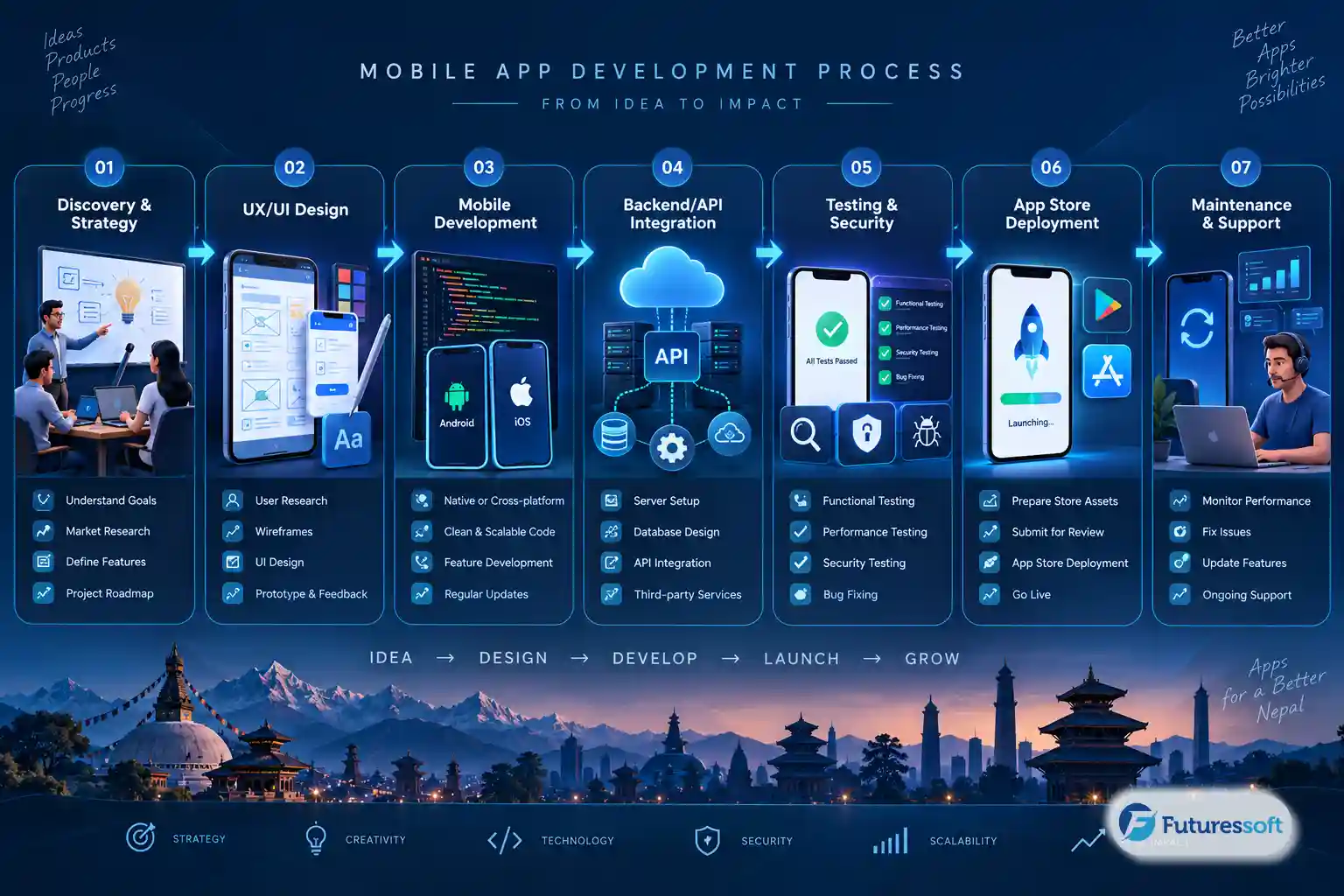
Mobile App Development Process
A properly run mobile app project follows a structured process rather than jumping straight into design or code. This mirrors how we structure delivery generally, laid out in more detail on our software development process page:
-
Discovery & strategy understanding your users, business goals, and constraints before any screens are designed
-
UX/UI design & architecture wireframes, prototypes, and a technical plan for how the app and backend will scale
-
Development building the app (native or cross-platform) alongside the backend and APIs it depends on
-
API & backend integration connecting payments, SMS/OTP, maps, and any third-party services
-
Quality assurance & security functional, performance, and security testing across real device conditions, not just a simulator
-
App store deployment preparing listings, screenshots, and metadata, and getting the app through Google Play and Apple App Store review
-
Maintenance & support OS updates, bug fixes, performance monitoring, and new features after launch
Skipping or rushing the first step is the most common reason mobile app projects end up over budget or misaligned with how the business actually works, the same pattern we've seen play out on the web application side, covered here.
How Long Does It Take to Build a Mobile App in Nepal?
|
Project Type |
Typical Planning Timeline |
|
Basic MVP |
A few weeks |
|
Business app |
Several weeks to a few months |
|
E-commerce / booking app |
A few months |
|
Complex multi-role app |
Several months |
|
Enterprise platform |
Longer, delivered in phases |
Scope drives timeline far more than raw app size does. A "simple" app with a complicated payment integration or a strict app-store review process can easily take longer than a larger app with straightforward requirements. Requirement changes mid-project are the single biggest cause of timelines slipping which is exactly why a proper discovery phase up front tends to save time later, not cost it.
How to Reduce App Development Cost Without Building a Cheap App
Controlling cost doesn't have to mean cutting corners. A few approaches that genuinely help:
- Start with an MVP. Launch with the features that matter most and validate demand before building everything.
-
Prioritize high-value features first. Not every feature on a wish list needs to ship on day one.
-
Avoid changing requirements mid-project. Scope changes are one of the most common causes of both delays and budget overruns.
-
Choose cross-platform when it fits. Flutter or React Native can meaningfully reduce cost when a highly custom, platform-specific experience isn't required.
-
Use established third-party services. Proven payment gateways and SMS providers are usually cheaper and more reliable than building equivalents from scratch.
-
Design the workflow before writing code. Time spent on wireframes and user flows up front is far cheaper than reworking built features later.
-
Phase advanced features. Real-time tracking, AI-driven recommendations, or complex analytics can often be a version 2 rather than a launch requirement.
-
Budget for maintenance from the start. An app that isn't maintained degrades through OS updates, security gaps, and app store policy changes faster than most businesses expect.
How to Choose a Mobile App Development Company in Nepal
A few things worth checking before committing to any vendor:
- Relevant technical experience not just "we can build anything," but evidence of similar projects
-
Ask for live applications, not only screenshots or mockups a link to the actual app store listing tells you more than a portfolio slide
-
Understand who owns the source code once the project is delivered
-
Ask how security and testing are handled, not just assumed
-
Ask how APIs and third-party integrations are managed payment gateways especially
-
Confirm post-launch support what happens when the OS updates or something breaks
-
Review how the team communicates during the project, not just at the sales stage
-
Get scope documented before pricing is finalized vague scope is how budgets balloon
Why Businesses Work With Futuressoft for Mobile App Development
Futuressoft is a software development company based in Lalitpur, building custom mobile applications for iOS and Android alongside the web applications, custom software, and cloud infrastructure we deliver for clients in Nepal and internationally. Our mobile app development services include native iOS development in Swift, Android development, cross-platform builds using Flutter and React Native, and ongoing app maintenance and support built on secure architecture and infrastructure designed to scale as usage grows.
Our project history spans media, travel, finance, and enterprise clients, documented in our case studies, and every engagement follows the same discovery-first delivery approach outlined on our process page because a mobile app that's scoped properly before development starts is far less likely to need an expensive rebuild a year in.
Frequently Asked Questions About Mobile App Development in Nepal
How much does mobile app development cost in Nepal in 2026?
It depends heavily on scope; a basic MVP costs far less than a multi-role app with payments, real-time tracking, and integrations. See the planning tiers above, and our broader cost framework in Custom Software Development Cost in Nepal 2026.
How long does it take to build a mobile app?
Anywhere from a few weeks for a basic MVP to several months for a complex, multi-role platform. Scope and integrations matter more than the app's overall size.
How much does an Android app cost in Nepal?
It depends on the same factors as any app complexity, backend, integrations, and design rather than the platform alone.
How much does an iOS app cost?
Similar drivers apply, though iOS development and app store review can add some additional time and QA overhead compared to Android.
Is Flutter good for mobile app development?
Yes it's a strong choice for apps that need a highly custom, consistent interface across both Android and iOS from a single codebase.
Is React Native good for business apps?
Yes, particularly for teams already working in JavaScript/React, or apps that lean on the wider React Native ecosystem.
Should I build Android and iOS at the same time?
Not necessarily. Many businesses launch on the platform that matches their core audience first, then expand once the app has proven demand.
Can a mobile app integrate with eSewa or other payment services?
Yes payment gateway integration is a standard part of most commercial app builds in Nepal.
Does a mobile app need a backend?
Almost always, unless it's a purely offline, static utility app. Accounts, data, and business logic typically live on a server the app talks to.
How much does app maintenance cost?
It varies by app complexity, but ongoing maintenance OS compatibility, security patches, bug fixes should be budgeted as a recurring cost, not treated as optional.
Can Futuressoft develop the backend and admin panel too?
Yes, our mobile app projects typically include the backend, APIs, and admin dashboard alongside the app itself, not just the front-facing screens.
Final Thoughts
The businesses that get the most value from a mobile app are the ones that start from a real user problem, something people will actually open the app to solve rather than building an app because competitors have one. Cost, platform choice, and framework all matter, but they're downstream decisions. The upstream one is understanding who the app is for, what they need to do in it, and what "done" actually looks like for version one.
If you have a mobile app idea and want to talk through scope, platform choice, and a realistic development roadmap, schedule a call with Futuressoft.
Related Insights