
School Website Development in Nepal
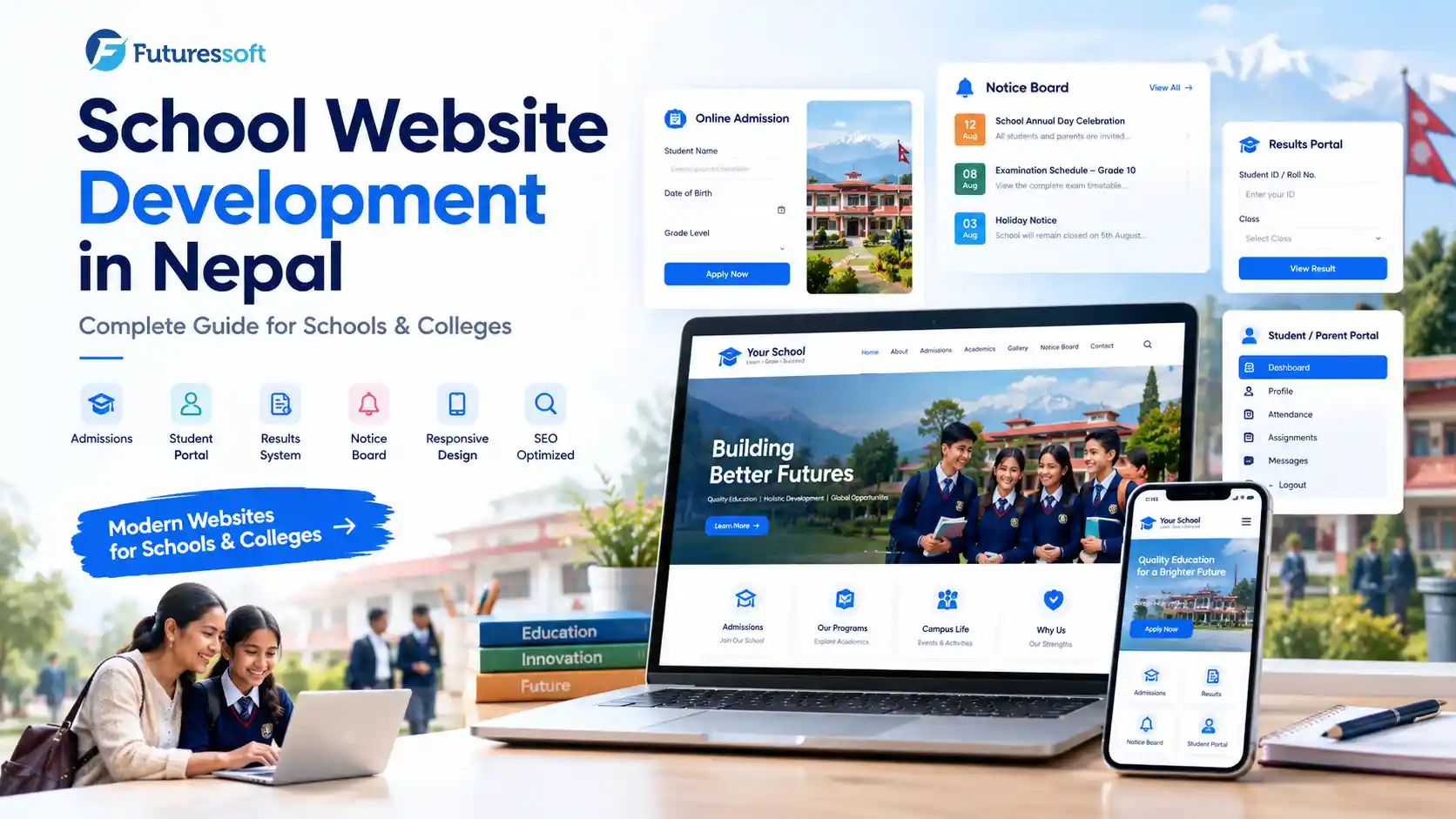
Ask any school principal in Kathmandu, Pokhara, or Biratnagar how parents find them today, and almost none will say "word of mouth" first anymore. They'll say Google. A parent shortlisting schools for their child now does what any of us do before a big decision: searches, compares, checks photos, reads about the admission process, and quietly decides whether the institution "feels" credible, all before ever calling the office.
That shift is why a website is no longer a nice-to-have for schools and colleges in Nepal; it's the front door. According to DataReportal's Digital 2026 Nepal report, the country has roughly 16.6 million internet users and over 32 million active mobile connections, more than the total population. Most of that traffic happens on a phone, and a large share of it happens on Facebook and Google, exactly where a parent starts researching schools.
If your institution's website is a static, outdated brochure or worse, doesn't exist, you're invisible during the exact moment a parent is deciding where to enroll their child. This guide walks through why schools in Nepal need a proper website, what features actually matter, how much it should realistically cost, and how to make sure the site gets found on Google in the first place.
Why Every School in Nepal Needs a Professional Website
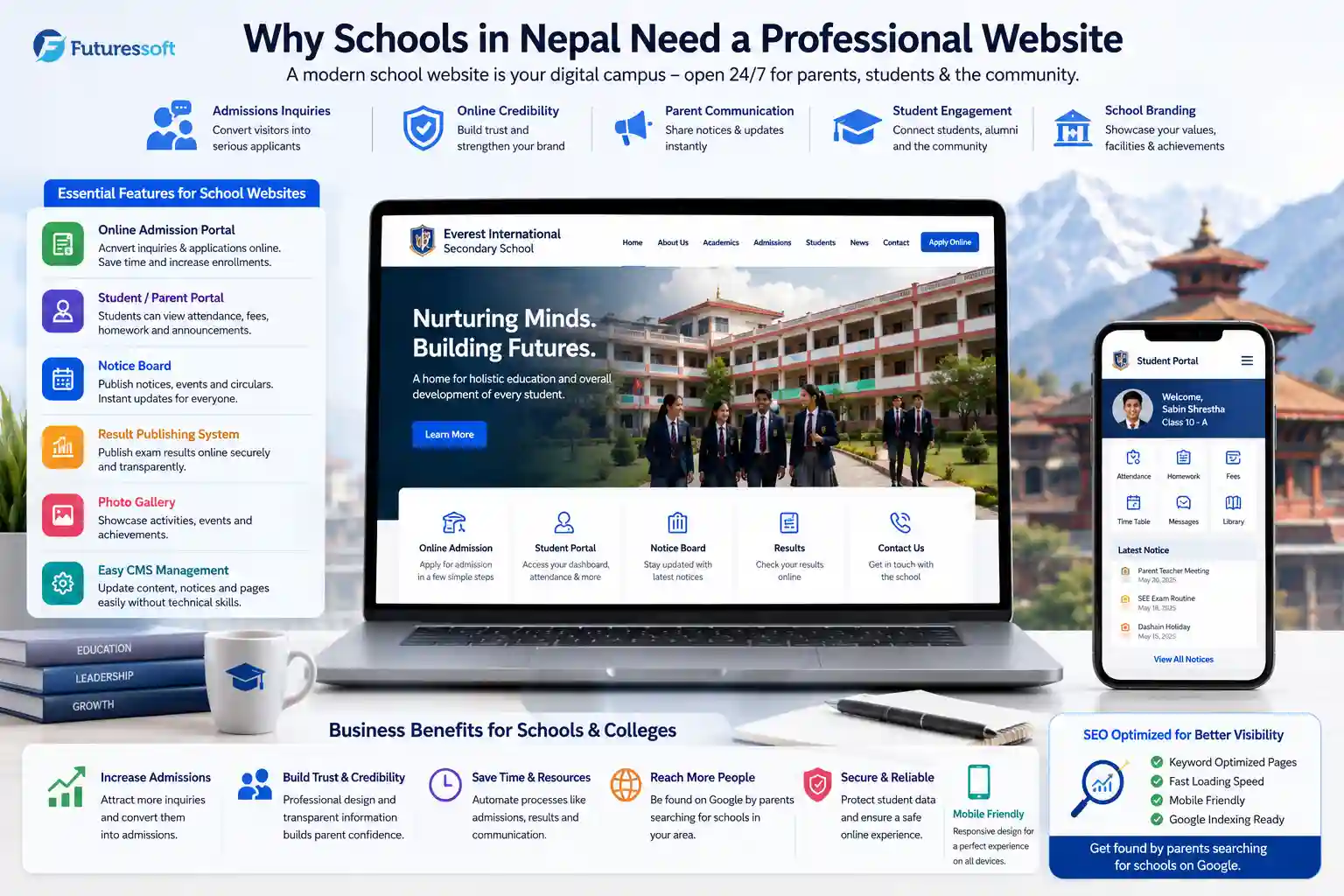
A school website does more than list an address and a phone number. It carries five jobs at once:
- Admissions inquiries. It's the first stop for parents deciding whether to visit in person. A confusing or missing admission page loses inquiries before they ever reach your front desk.
-
Online credibility. Parents mentally cross off schools that look unprofessional online, even if the institution itself is excellent. A clean, modern site signals that the school takes itself seriously.
-
Parent communication. Notices, exam schedules, holiday announcements, and results reach hundreds of parents instantly instead of through printed notices that get lost.
-
Student engagement. Galleries, achievements, and student portals give current students and alumni a reason to keep coming back to the site.
-
School branding. A well-designed website communicates values, teaching philosophy, and facilities in a way a signboard or pamphlet never can.
None of this requires a huge budget; it requires the site to be built with these five jobs in mind from day one, rather than as an afterthought.
Benefits of School Website Development
Improve admissions. A clear admission page with dates, eligibility, fee structure, and an online inquiry or application form converts casual browsers into serious applicants and gives your admission team pre-filled data instead of walk-in guesswork.
Build trust with parents. Faculty profiles, infrastructure photos, accreditation details, and past results build the kind of quiet confidence that gets a school onto a parent's shortlist.
Publish notices instantly. A notice board on the website (ideally paired with a WhatsApp or SMS alert) means exam dates, holidays, and emergency closures reach every parent the moment they're posted, not two days later through a paper notice.
Showcase facilities and achievements. Labs, libraries, sports grounds, cultural events, Olympiad wins, and board-exam toppers are strong differentiators but only if there's a place on the site built to show them off properly.
Generate more enrollment leads. Every additional inquiry captured through a well-placed form on the admission page is a lead your front office didn't have to chase down.
Essential Features of a School Website
These are the baseline features every school or college website in Nepal should have, regardless of budget:
- Homepage a clear first impression: who you are, what makes the school different, and a direct path to admissions.
-
About the School history, vision/mission, management, and accreditation (SEE/NEB affiliation, university affiliation for colleges, etc.).
-
Admission Page dates, process, eligibility, fee structure, and an online inquiry or application form.
-
Academic Calendar term dates, exam schedules, and holidays in one place, ideally downloadable.
-
Faculty Section teacher profiles with qualifications, building parent confidence in who's teaching their child.
-
News & Notice Board the single most-visited page after admissions on most school sites, and the easiest to keep updated if built on a proper CMS.
-
Photo/Video Gallery events, campus life, and facilities, organized by year or category rather than dumped into one long feed.
-
Downloads Section syllabus, forms, fee structure PDFs, and circulars in one predictable place.
-
Contact Page & Google Maps Integration address, phone, email, and an embedded map, since many parents are locating the campus for the first time.
Advanced Features Schools Should Consider
Once the essentials are in place, these features are where a school website starts doing real administrative work instead of just presenting information:
- Online Admission System parents apply and pay an inquiry/application fee directly through the site instead of visiting in person.
-
Student Portal / Parent Portal secure logins where students and parents can check attendance, homework, fee dues, and results.
-
Online Result System results published securely by roll number or login, following the grading structure used for SEE, NEB, or the school's own internal system.
-
Fee Payment Integration local gateways like eSewa and Khalti let parents pay tuition and admission fees online rather than standing in a queue at the accounts office.
-
SMS/Notification Alerts critical for schools where parents may not check the website daily but will read an SMS.
-
Teacher Dashboard a lightweight backend for teachers to upload homework, marks, or attendance without needing IT support.
-
Attendance Tracking daily attendance visible to parents, often the single most-requested feature once a portal exists.
-
Bilingual (Nepali + English) content many Nepal-based schools serve both English-medium and Nepali-speaking families; a bilingual site widens your reach and improves trust with local parents specifically.
Not every school needs all of these on day one. A growing private school in its first two years usually gets more value from a strong marketing website with an admission form; a well-established school with 1,000+ students usually reaches a point where a result system and parent portal save real administrative hours every week.
School Website vs. School Management Software: What's the Difference?
This is one of the most common points of confusion for school administrators, and it's worth being precise about, because the two solve different problems.
|
School Website |
School Management Software |
|
|
Audience |
Public prospective parents, students, the general public |
Internal staff, existing students, existing parents |
|
Primary job |
Marketing, admissions, credibility, communication |
Day-to-day operations: attendance, fees, exams, payroll |
|
Typical features |
Homepage, admissions, notices, gallery, SEO |
Attendance tracking, fee collection, report cards, HR/payroll |
|
Visibility |
Public and search-engine indexed |
Private, login-only, generally not indexed |
|
Goal |
Get more inquiries and build trust |
Reduce administrative workload and errors |
In practice, the strongest setup is a public website for admissions and credibility, connected to a student/parent portal that talks to your internal management system for results, attendance, and fees so a parent can move seamlessly from "researching the school" to "logged in checking their child's report card" without leaving your domain. This is exactly the kind of layered build a marketing-facing website backed by a proper web application that a web application development team plans for from the architecture stage, rather than bolting a portal onto a template site later.
Key Pages Every School Website Must Have
Beyond the homepage, a handful of pages carry most of the traffic and conversions on a school site:
- Admission Page should stand entirely on its own with dates, process, fees, and a form; don't bury it inside "About."
-
Result Page secure, roll-number or login-based, with clear instructions for parents who aren't tech-savvy.
-
Notice Board chronological, filterable by category (exam, holiday, event, admission).
-
Faculty Page searchable or grouped by department/level for larger institutions.
-
Events Page annual functions, sports day, cultural programs — great for both parent engagement and SEO, since event pages naturally attract fresh, keyword-rich content over time.
-
Alumni Page increasingly requested by established schools and colleges; alumni stories are strong trust signals for new parents.
-
Contact Page address, phone, embedded map, and ideally a WhatsApp or inquiry-form option, since that's how most Nepali parents already prefer to reach out.
Mobile-Responsive School Websites
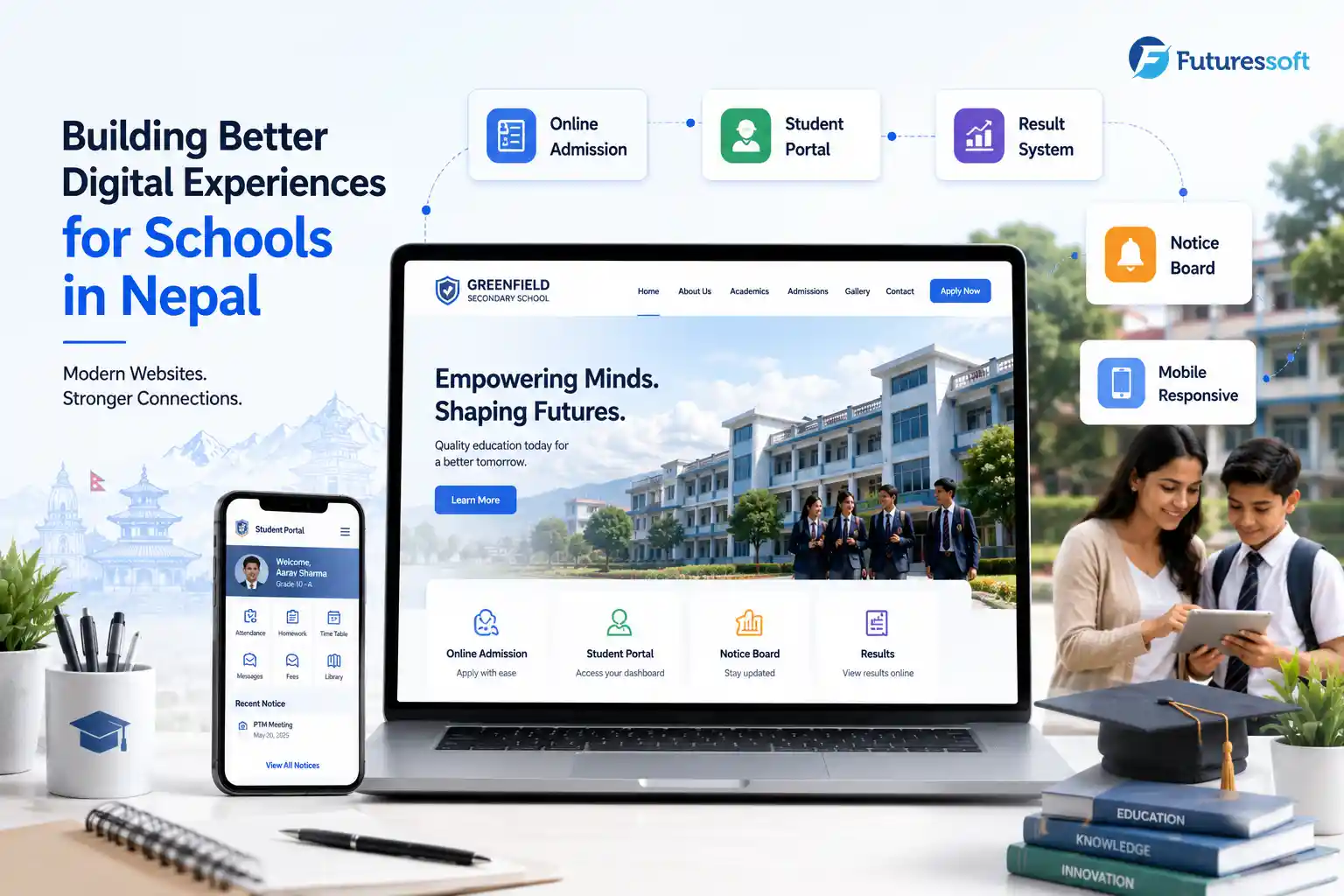
With well over 30 million active mobile connections in Nepal and the vast majority of parents browsing on a phone rather than a desktop, a school website that isn't properly responsive is quietly turning away a large share of its visitors before they even read a page. This isn't just a design preference; it directly affects search rankings too, since Google now indexes and ranks sites primarily based on how they perform on mobile devices, not desktop.
Practically, this means:
- Forms (admission inquiry, contact) must be easy to fill out one-thumbed on a small screen.
-
Notice boards and result pages should load quickly even on 3G/4G connections in areas with weaker network coverage.
-
Images and galleries should compress properly rather than dragging load times out to the point where a parent gives up and leaves.
SEO for School Websites
Building the site is half the job getting it found is the other half. A few things matter far more than most schools realize:
- Local SEO. Most parents search with location intent "school in Kathmandu," "school in Lalitpur," "school in Pokhara" so location-specific content, an address in your footer, and consistent NAP (Name, Address, Phone) details across the web all matter.
-
Google Business Profile. A claimed, fully filled-out profile with photos, hours, and a link to the admission page often outranks the website itself for "school near me" searches and it's free.
-
Schema markup. Structured data (EducationalOrganization schema) helps Google understand your school's name, address, and even events or notices, which can surface richer results in search.
-
Fast-loading pages. Every extra second of load time increases the chance a parent bounces before reading anything especially on mobile networks that aren't always fast.
-
Location + intent keywords. Beyond "school in [city]," long-tail phrases like "best school in Kathmandu for admission 2083" or "school admission open Nepal" tend to convert better because the searcher is closer to a decision.
Common Mistakes Schools Make With Their Websites
A few patterns show up again and again in school websites across Nepal, and they're worth avoiding deliberately:
- Treating the site as a one-time project. A website built once and never updated goes stale fast outdated notices and last year's admission dates actively hurt credibility.
-
No one owns content updates. Without a simple CMS and a staff member responsible for it, the notice board quietly stops updating within a few months of launch.
-
Ignoring page speed. Heavy, unoptimized images and bloated templates are the single most common reason school sites feel slow on mobile.
-
Skipping SEO entirely. A beautiful website that doesn't rank for "school in [city]" or the school's own name is invisible to exactly the parents searching for it.
-
Building the portal and the website as two disconnected systems. This creates duplicate logins, mismatched data, and a confusing experience for parents.
Know more on : Custom Software Development, Mobile Apps & Cloud Solutions
School Website Development Cost in Nepal
Pricing in Nepal's web development market varies widely; a freelancer might quote NPR 15,000 for a template site while an agency quotes NPR 500,000+ for a custom platform, and both can be the "right" price depending on what the school actually needs. For school and college websites specifically, based on current market rates, budgets typically fall into three tiers:
|
Package |
Approx. Cost (NPR) |
What's Usually Included |
|
Basic School Website |
40,000 – 80,000 |
Homepage, about, admission page with a simple inquiry form, notice board, gallery, contact page — usually template-based or lightly customized |
|
Standard School Website |
80,000 – 200,000 |
Fully custom design, CMS so staff can update notices/gallery themselves, bilingual support, faculty/events pages, stronger on-page SEO |
|
Advanced School Portal |
200,000 – 600,000+ |
Custom-built site plus student/parent portal, online admission system, result publishing, fee payment integration (eSewa/Khalti), SMS alerts, and a management dashboard |
A few things move the price meaningfully in either direction:
- Custom design vs. template. A bespoke UI/UX for your school's branding costs more than a themed design, but it's the difference between "looks like every other school site" and one that actually reflects your institution.
-
CMS complexity. A simple notice board is cheap to build; a full CMS where non-technical staff manage every page, image, and PDF costs more but saves recurring developer fees for years afterward.
-
Portals and integrations. Anything involving logins, payments, or SMS naturally adds development and testing time, since it touches real student data and money.
-
Ongoing maintenance. The budget for hosting, a domain, and light annual maintenance separately from a school website is not a one-time expense, even at the basic tier.
The cheapest option isn't always the most cost-effective one. A NPR 15,000 template site with no CMS often ends up costing more within a year, once you factor in the developer fee every time a notice needs updating.
How to Choose the Right School Website Development Partner
A handful of questions separate a good partner from a risky one:
- Do they understand Nepal's education system? SEE and NEB grading, term structures, and how Nepali parents actually search and behave online aren't things a generic international template accounts for.
-
Can they build both the website and the portal, on one platform? Avoids the disconnected-systems problem covered above.
-
Do they offer a CMS your own staff can use? If every notice update requires calling the developer, the site will fall behind within months.
-
Do they think about SEO from day one, not as an afterthought? A site that isn't built with clean structure, fast loading, and proper metadata from the start is expensive to fix later.
-
Do they have a track record with real institutions? Ask to see live examples, not just mockups.
This is also where it's worth thinking slightly beyond "just a website." Many schools eventually want a result system, a fee-payment portal, or an attendance dashboard and building the marketing website on the same technical foundation as those future systems saves a costly rebuild later. It's the same reasoning covered in our guide on signs your business needs custom software: once an organization's needs go beyond "just present information," a properly architected custom software foundation pays for itself.
Why Futuressoft for School Website Development in Nepal
Futuressoft is a Lalitpur-based software development company that builds custom websites, web applications, and enterprise-grade CMS platforms for organizations across Nepal from media houses and news portals to service businesses and educational institutions. That CMS and content-platform experience is directly relevant to schools: the same underlying skill that lets a newsroom publish and manage thousands of articles reliably is what lets a school's front office update a notice board or publish results without waiting on a developer.
Our approach for a school or college website typically includes:
- A custom-designed, mobile-first website built around admissions and credibility, not a recycled template.
-
A CMS your own staff can actually use no developer needed for routine updates.
-
Optional student/parent portals, online admission forms, and result publishing built on the same platform as the public website, so there's one system, not two.
-
SEO is structured from the start with clean URLs, fast loading, local SEO, and schema markup so the site is built to be found, not just to look good.
If your school or college is planning a new website, or if your current one is outdated, slow, or invisible on Google, our team can walk through what a build would actually look like for your institution. You can see examples of our work in our case studies or schedule a call to talk through your requirements directly.
Looking to build or upgrade your school or college website? Talk to Futuressoft about a custom school website development project from a straightforward admissions-focused site to a full student and parent portal.
Related Insights