Travel Software Development: Complete Guide
A traveler today doesn't call a travel agent and wait for a callback. They open a phone, compare three or four booking platforms in about ninety seconds, and expect real-time prices, instant confirmation, and a smooth checkout — all before they've finished their coffee. That shift didn't happen overnight, but it happened fast enough that a lot of travel agencies, tour operators, and DMCs are still catching up.
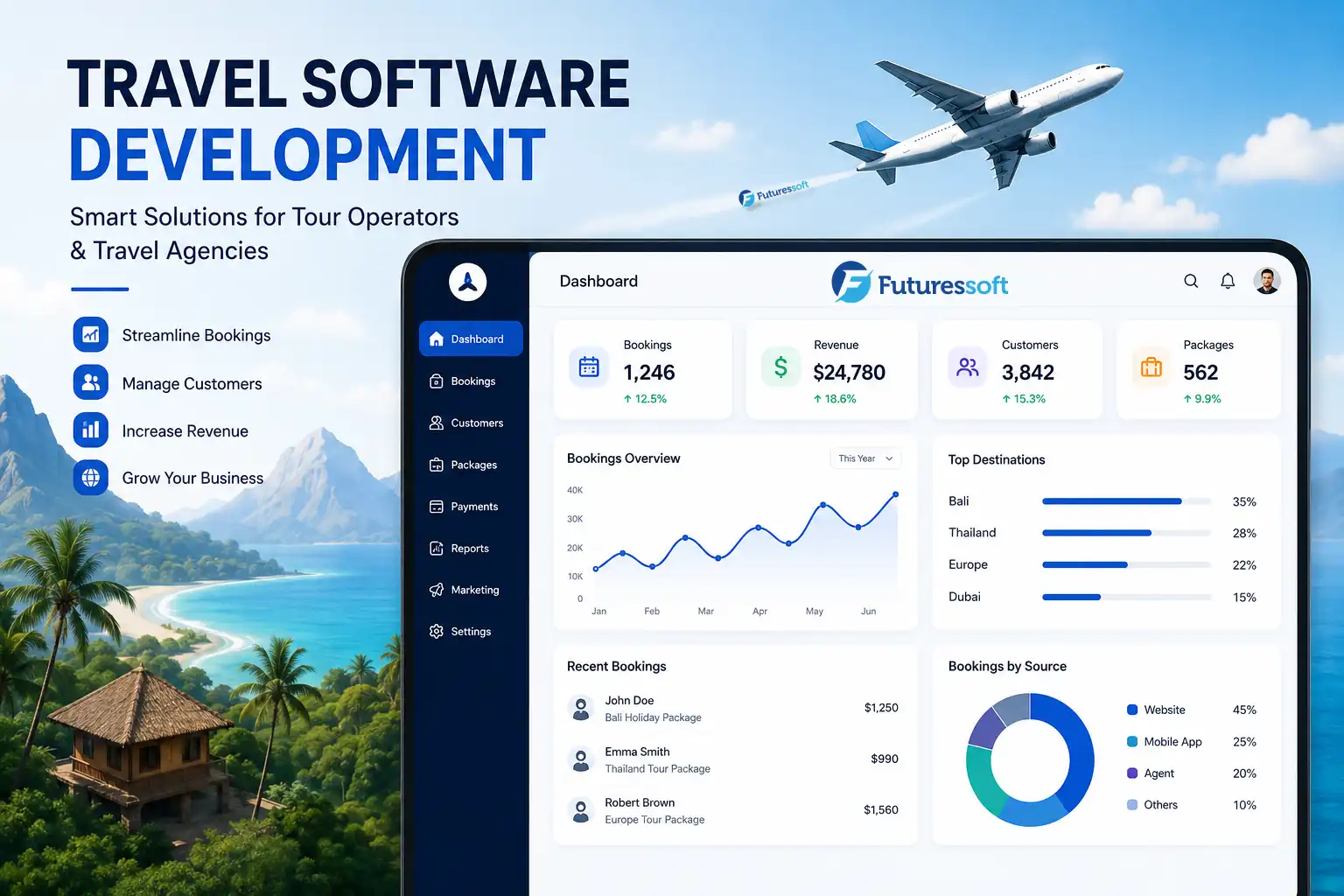
This is really what travel software development is about. It isn't just "building a website for a travel company." It's the process of designing and engineering the booking engines, CRMs, ERPs, mobile apps, and back-office systems that let a travel business actually operate at the speed its customers expect — while giving the team behind the scenes a way to manage packages, payments, and itineraries without living inside a spreadsheet.
In this guide, we'll walk through what travel software development actually involves, the different types of systems travel businesses use, the features that matter most in 2026, what it typically costs, and how AI is starting to change the booking experience. Along the way, we'll draw on real project experience — including how we built a trekking and adventure travel platform for Nisraj Tours & Travels, a Nepal-based operator running trips across Nepal, Bhutan, and Tibet.
What Is Travel Software Development?
Travel software development is the design, engineering, and deployment of digital systems built specifically for the travel and tourism industry — booking engines, reservation systems, travel CRMs, tour operator platforms, hotel and package management tools, and the mobile apps that sit on top of them.
The purpose is fairly simple to state, even if the execution isn't: replace manual, phone-and-email-based booking workflows with a connected digital system that lets customers search, compare, and book on their own, while giving the business owner one place to manage inventory, pricing, payments, and customer relationships.
It serves a wide range of businesses across the industry, including:
- Tour operators and adventure travel companies
-
Travel agencies (retail and corporate)
-
Destination management companies (DMCs)
-
Hotels, resorts, and homestay networks
-
Airlines and ground transport providers
-
Online travel aggregators (OTAs) and marketplaces
-
Travel media and content platforms
What ties all of these together is that travel is a high-consideration, detail-heavy purchase. A customer booking a two-week trekking package in the Himalayas is weighing dates, altitude, group size, permits, and budget all at once — very different from adding a t-shirt to a cart. Good travel software is built around that complexity, not despite it.
Why Travel Businesses Need Custom Software
Off-the-shelf booking plugins and generic website builders can get a small operator online quickly, but most travel businesses eventually hit a wall with them. Here's why custom software tends to make more sense as a business grows.
Manual processes don't scale. If your team is still confirming trips over WhatsApp, updating availability in a shared spreadsheet, and manually calculating package prices for every inquiry, you're capping how many customers you can serve — no matter how good the itineraries are.
Booking management gets messy fast. Multiple destinations, seasonal pricing, group discounts, add-ons, and cancellation policies are hard to manage consistently without a system designed to handle that logic. A generic e-commerce plugin usually isn't built for it.
Customer experience is the differentiator now. When two operators offer similar treks or tour packages, the one with a faster, clearer, mobile-friendly booking flow tends to win the inquiry — even if the itinerary itself is nearly identical.
Revenue growth needs infrastructure, not guesswork. A custom platform can support upselling (add-ons, insurance, gear rental), dynamic pricing by season or demand, and better reporting — all of which directly affect margin, not just traffic.
None of this means every travel business needs a six-figure custom build on day one. But it does mean the systems you choose should be able to grow with you, rather than becoming the thing that holds you back at 10x the bookings.
Types of Travel Software
"Travel software" is a broad label. In practice, most travel businesses end up using — or eventually need — some combination of the following systems.
Travel Booking Software
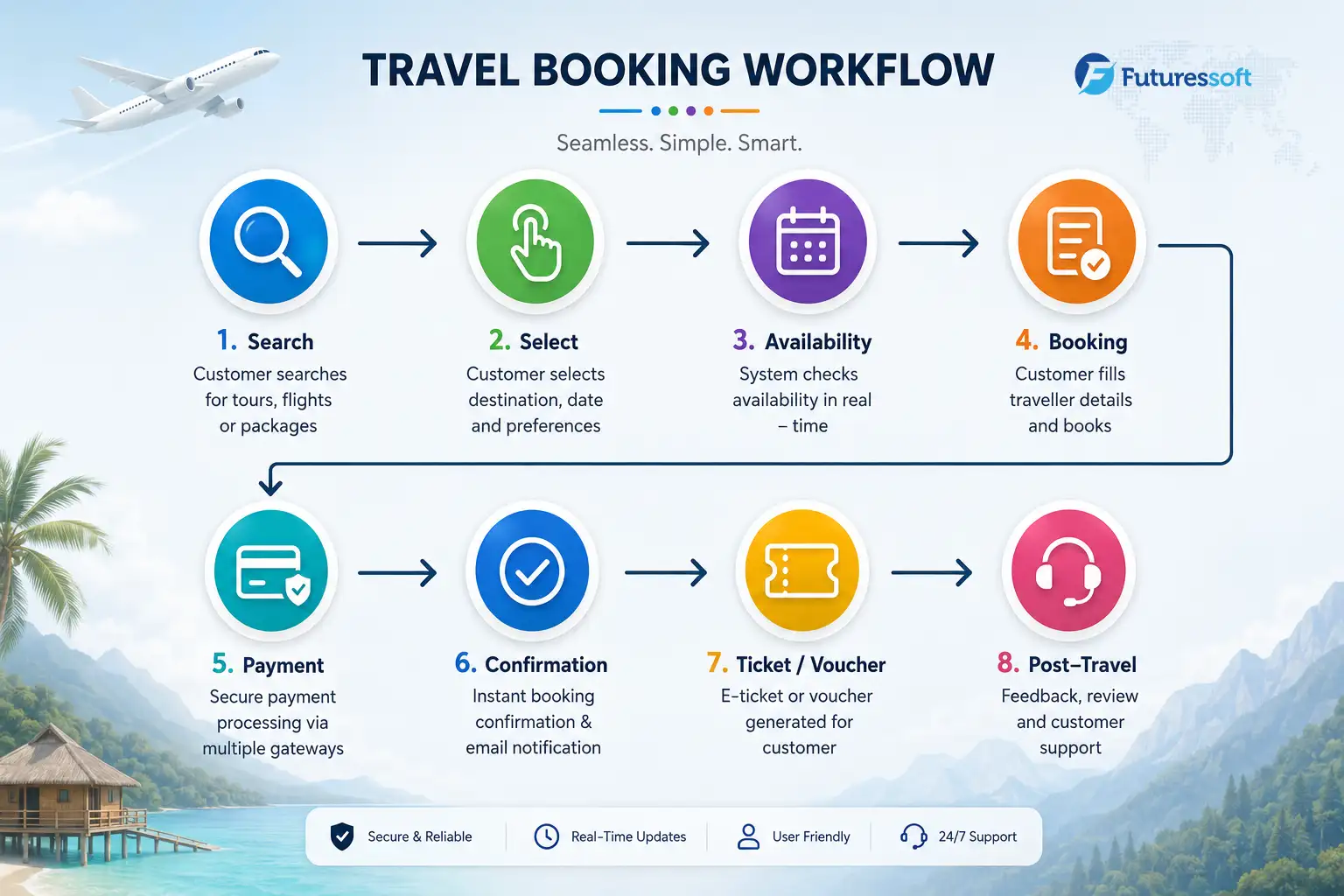
This is the customer-facing engine: search, availability, pricing, and checkout. It's what lets a visitor go from "browsing treks in Nepal" to "confirmed booking" without a phone call. A strong booking system handles multi-package comparisons, date-based availability, and secure payment collection in one flow.
Travel Agency CRM
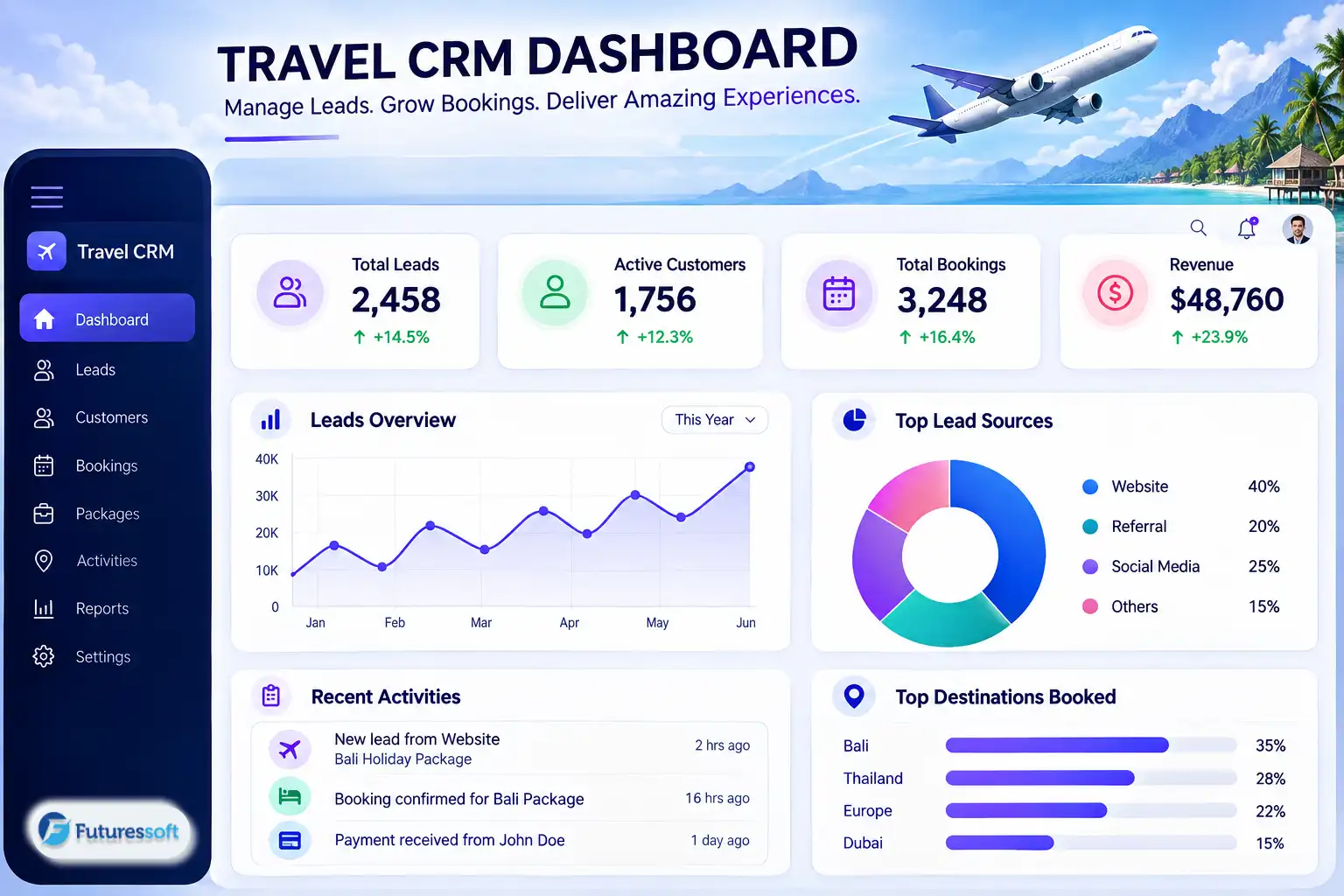
A travel CRM tracks leads, inquiries, past travelers, and follow-ups in one place. For agencies that sell high-value, considered trips, this matters more than most people expect — a well-timed follow-up on an abandoned inquiry can be the difference between a booking and a lost lead.
Travel ERP
Larger operators and DMCs often need an ERP layer to tie bookings together with finance, vendor payments, guide and staff scheduling, and inventory across multiple destinations or branches. This is less visible to the customer but critical to running the business efficiently at scale.
Hotel Management System
For hotels, resorts, and homestay networks, this covers room inventory, rate management, channel distribution (syncing availability across OTAs), and front-desk operations, usually connected to a booking engine on the website itself.
Tour Operator Software
Purpose-built for companies selling packaged experiences — treks, expeditions, cultural tours, day trips. This typically includes itinerary builders, package and pricing management, group booking tools, and destination-based content structures, similar to what we built for Nisraj Tours & Travels' trekking and expedition catalog.
Travel Mobile Apps
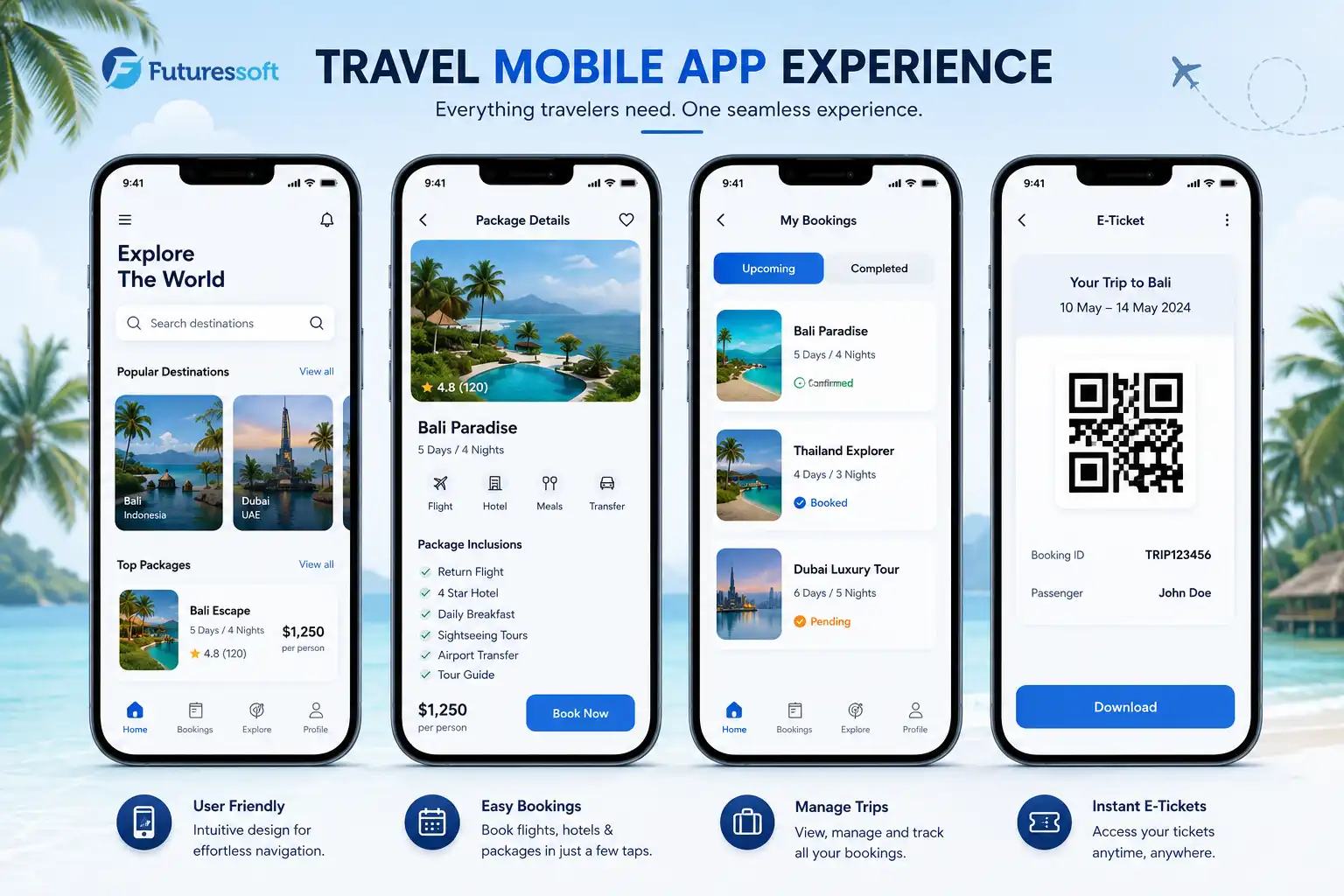
A companion or standalone app for browsing packages, managing bookings, receiving trip updates, and — for larger platforms — real-time itinerary tools, offline maps, or digital travel documents.
Essential Features of Modern Travel Software
Regardless of which type of platform you're building, a handful of features have become close to non-negotiable for a travel platform in 2026:
-
Online booking and real-time availability — no back-and-forth required to confirm a date
-
Secure payment gateway integration — supporting cards, wallets, and regional payment methods
-
Customer dashboard — for viewing bookings, documents, and trip status
-
Admin panel — a single place to manage packages, pricing, and inquiries
-
Tour and package management — structured itineraries, inclusions/exclusions, and add-ons
-
CRM integration — so no inquiry falls through the cracks
-
Reporting and analytics — bookings, revenue, and traffic in one view
-
Reviews and ratings — social proof that visibly builds trust
-
Interactive maps — for itineraries, routes, and destination overviews
-
Automated notifications — booking confirmations, reminders, and trip updates via email/SMS
-
Multi-language support — essential for reaching international travelers
-
Multi-currency support — so pricing displays correctly for the traveler's region
-
Third-party API integrations — maps, payments, weather, communication tools
-
Mobile responsiveness — the majority of travel research now happens on a phone
The trap a lot of travel websites fall into is trying to launch everything at once. In practice, it's usually smarter to get the booking flow, package management, and mobile experience right first, then layer in CRM automation, reviews, and multi-currency support as the business grows.
Travel Website vs Travel Mobile App
One of the most common questions travel business owners ask is whether they need a website, an app, or both. The honest answer is: most businesses should start with a strong website, and add an app once there's a clear, repeat-usage reason for one.
|
Travel Website |
Travel Mobile App |
|
|
Best for |
First-time visitors, SEO-driven discovery, browsing packages |
Repeat customers, loyalty features, on-trip tools |
|
Discoverability |
High — indexable by Google, shareable links |
Low — requires a download decision first |
|
Development cost |
Generally lower |
Generally higher (native or cross-platform build) |
|
Update speed |
Instant |
Subject to app store review for native apps |
|
Offline access |
Limited |
Can support offline maps/itineraries |
|
Ideal use case |
Marketing, booking, content, SEO |
Trip management, push notifications, loyalty programs |
For most tour operators and agencies, the website is the primary revenue driver — it's where SEO traffic lands and where most bookings originate. An app tends to make the most sense once you have a loyal repeat-customer base who would genuinely benefit from push notifications, saved itineraries, or offline access during a trip with limited connectivity — which is especially relevant for trekking and expedition companies operating in remote regions.
Travel Website Development Process
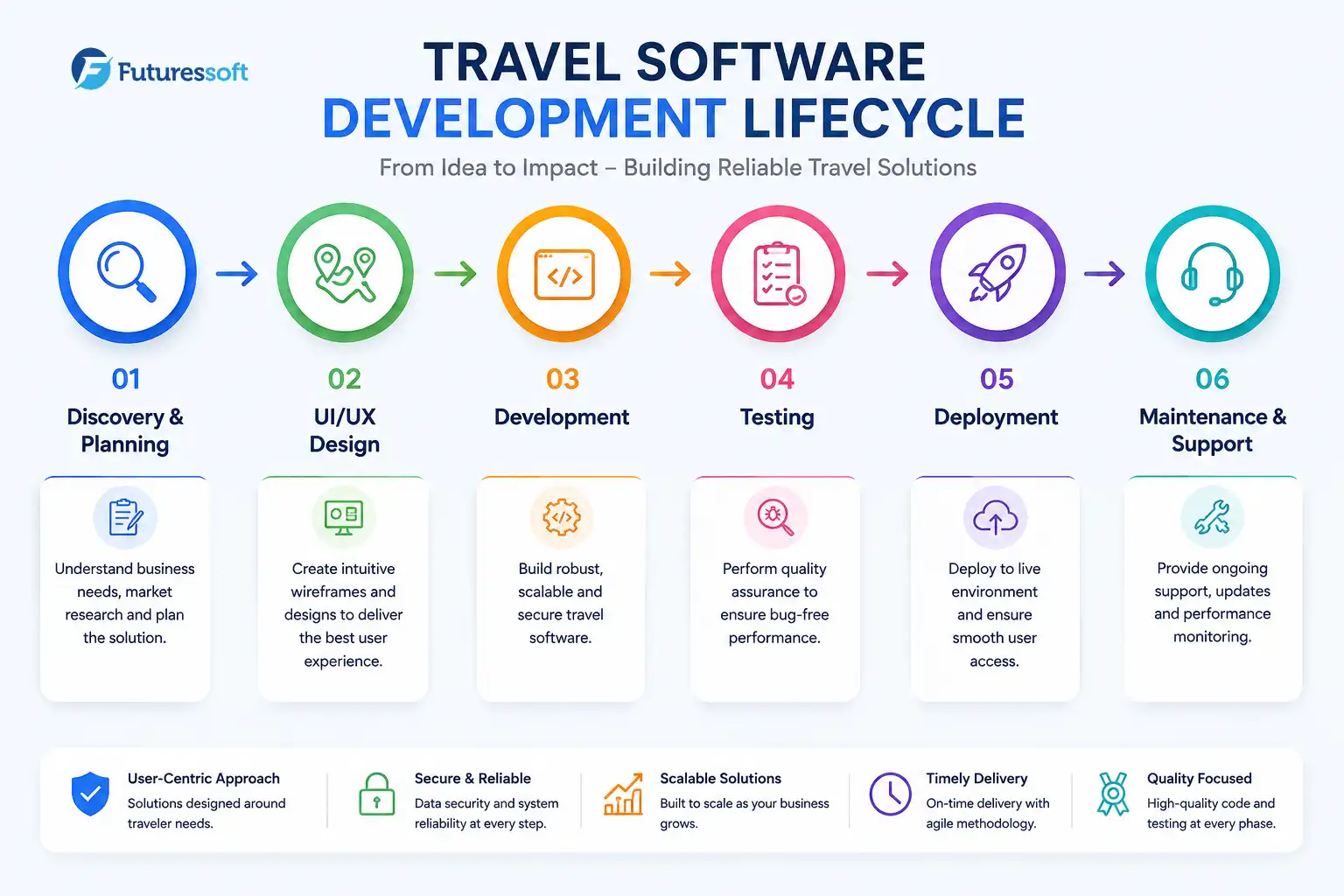
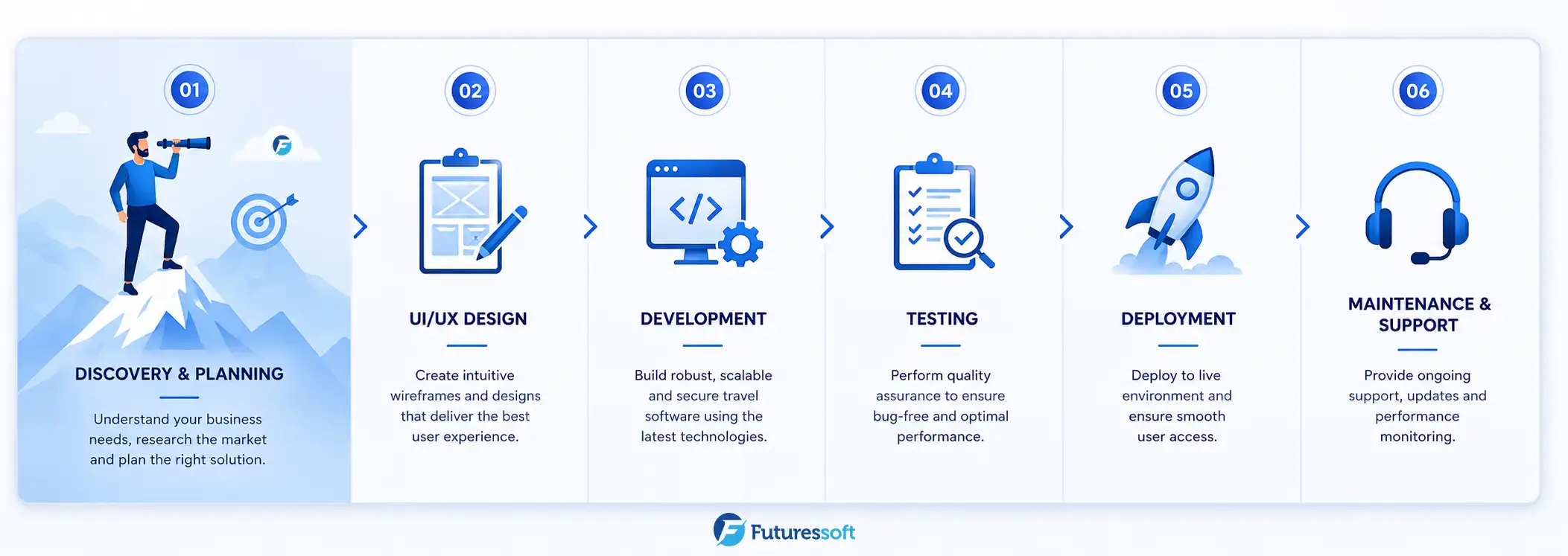
A well-run travel software project generally moves through six stages:
1. Discovery. Understanding the business — the types of packages sold, destinations covered, booking volume, existing tools, and where the current process breaks down. For a trekking operator, this might mean mapping out how permits, group sizes, and seasonal availability affect the booking flow; for a hotel, it might mean understanding rate parity across channels.
2. UI/UX Design. Wireframing and designing the booking flow, package pages, and admin dashboard before writing production code. Good travel UX front-loads the details travelers actually decide on — dates, group size, difficulty level, inclusions — rather than burying them behind extra clicks.
3. Development. Building the front end, back end, database, and integrations (payments, maps, CRM). This is also where the package management system and admin panel take shape, since that's what the internal team will use daily.
4. Testing. QA across devices and browsers, load testing for traffic spikes (peak booking season matters a lot in travel), and payment flow testing to make sure transactions are secure and reliable.
5. Deployment. Launching to production with proper hosting, SSL, backups, and monitoring in place from day one.
6. Maintenance. Ongoing updates, security patches, seasonal content updates (new packages, pricing changes), and performance monitoring — travel platforms are rarely "done" the day they launch.
Best Technologies for Travel Software Development
The right stack depends on the platform's scale and complexity, but a few combinations have proven reliable across travel projects:
- Laravel / PHP — a solid, well-tested choice for content-heavy travel and tour operator sites, especially when paired with a CMS-driven package management system (this is the stack behind the Nisraj Tours & Travels platform)
-
Node.js — strong for real-time features like availability checks and booking notifications
-
React and Next.js — for fast, SEO-friendly front ends with server-side rendering, important for travel content that needs to rank in search
-
Vue.js and Angular — alternative front-end frameworks depending on team expertise and project requirements
-
Flutter — for cross-platform mobile apps that need to launch on iOS and Android from a single codebase
-
AWS, Azure, and Google Cloud — for hosting, scalability, and handling seasonal traffic spikes
-
Docker and Kubernetes — for containerized deployments that scale cleanly as booking volume grows
The right answer is almost never "use the newest framework." It's choosing a stack the development team can maintain reliably for years, since a travel platform is a long-term asset, not a one-off build.
Travel APIs Commonly Used in Travel Software
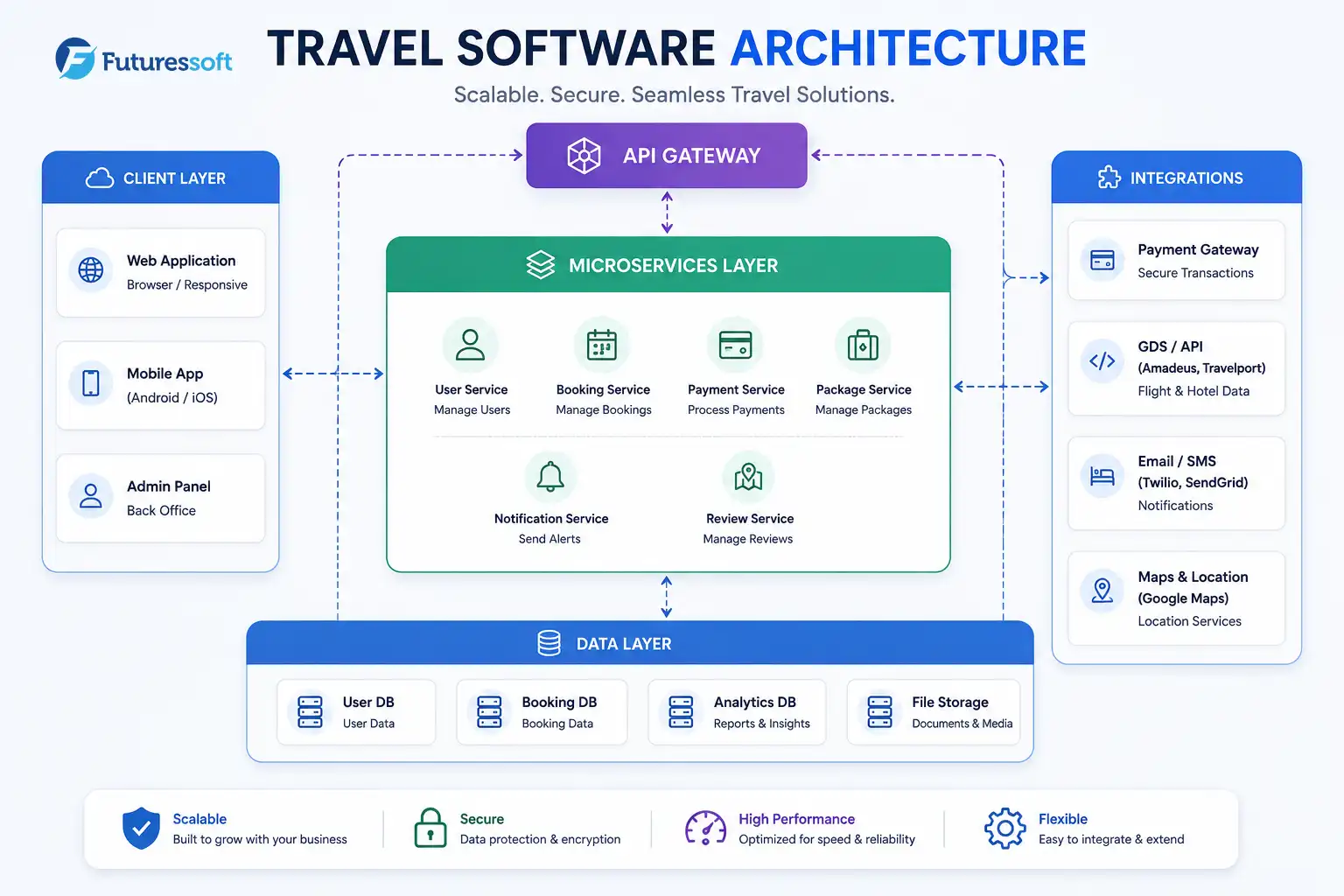
Most modern travel platforms are built by connecting a custom core system to a handful of specialized third-party APIs rather than building everything from scratch:
- Google Maps — destination maps, route visualization, location search
-
Amadeus — flight and travel content data for larger booking platforms
-
Stripe — international payment processing
-
Razorpay — payment processing across South Asian markets
-
OpenWeather — trip planning tools and destination weather data
-
Twilio — SMS notifications and booking confirmations
-
Firebase — push notifications and real-time app features
Integrating the right APIs early avoids a lot of rework later — swapping a payment gateway or maps provider after launch is far more disruptive than planning for it during the build.
AI in Travel Software
AI has moved from "nice to have" to something travelers increasingly expect, and it's showing up across the booking journey in a few concrete ways:
- AI chatbots that answer package questions instantly, 24/7, reducing the load on human support for repetitive queries
-
Personalized package recommendations based on browsing behavior, past bookings, or stated preferences
-
Smart search that understands natural queries ("moderate trek in Nepal, under 10 days") rather than requiring rigid filters
-
Dynamic pricing that adjusts based on demand, season, or booking lead time
-
Predictive analytics to forecast demand and help operators plan staffing, guides, and inventory
-
AI-driven recommendations that surface relevant add-ons travel insurance, gear rental, airport transfers at the right moment in checkout
The businesses getting real value from AI right now aren't necessarily the ones with the flashiest chatbot. They're the ones using it to remove friction from a specific, high-volume task answering FAQs, suggesting the right package, or flagging abandoned bookings for follow-up.
Travel Software Development Cost
Pricing for travel software varies widely depending on scope, so it's more useful to think in tiers than to chase a single number.
Basic tour operator or travel agency website (package listings, inquiry forms, CMS, responsive design): the smallest end of the range — suitable for operators who mainly need a professional, lead-generating web presence rather than a full transactional booking engine.
Mid-tier booking platform (online payments, trip finder/filtering, CRM integration, multi-destination content, admin dashboard): a mid-range investment, reflecting the added engineering around payments, search, and structured content — this tier is roughly comparable to what was built for Nisraj Tours & Travels.
Enterprise-grade travel platform or OTA (multi-vendor marketplace, ERP integration, custom APIs, mobile apps, high-availability infrastructure): the top end of the range, driven by the complexity of integrations, scalability requirements, and ongoing engineering support.
Factors that move a project up or down within these ranges include:
- Number of destinations, packages, and content pages
-
Whether you need a mobile app in addition to a website
-
Payment gateway and third-party API integrations
-
Level of design customization
-
CRM/ERP complexity and existing systems that need to connect in
-
Ongoing maintenance, hosting, and support requirements
The most reliable way to get an accurate figure is a scoping conversation — costs shift significantly based on whether you're digitizing an existing manual process or building a platform to compete with established OTAs.
Common Challenges in Travel Software Development
A few challenges come up repeatedly across travel software projects, and it's worth knowing about them going in:
Legacy systems. Many established travel businesses run on a patchwork of old booking tools, spreadsheets, and disconnected plugins. Migrating that data and those workflows without disrupting live bookings takes careful planning.
Scalability. Travel is seasonal — a platform that runs fine most of the year can buckle during peak booking season if it wasn't built to handle traffic spikes.
Security. Travel platforms handle payments and personal data (passport details, travel documents), which makes security and compliance a real engineering requirement, not an afterthought.
Payment complexity. Multi-currency pricing, regional payment methods, refunds, and partial payments (common for high-value trips like expeditions) all add complexity to the checkout flow.
Integrations. Connecting to maps, payment gateways, CRMs, and sometimes external inventory systems (for hotels or flights) requires careful API design so one failing integration doesn't break the whole booking flow.
Offline access. For adventure and trekking companies operating in remote regions, connectivity can't be assumed — itineraries, maps, or key trip information may need to be accessible offline.
Why Choose Futuressoft for Travel Software Development
We're a custom software development company based in Lalitpur, Nepal, working with businesses in Nepal and internationally — including media companies, financial institutions, and travel and tourism brands. Travel software sits well within what we do day to day: custom web application development, CMS platforms, and scalable backend systems.
A recent example is our work with Nisraj Tours & Travels, a Nepal-based adventure travel company running trekking, expedition, peak climbing, mountain biking, and cultural tour packages across Nepal, Bhutan, and Tibet. The business needed a way to organize hundreds of packages across three countries and multiple activity categories, while making it easy for travelers to actually find the right trip for their interests, timeframe, and budget.
We built a platform on Laravel-friendly, CMS-driven architecture (PHP, MySQL) with:
- A trip finder that filters packages by destination, activity, duration, budget, and region
-
Dedicated destination pages for Nepal, Bhutan, and Tibet, plus category pages for trekking, expeditions, peak climbing, mountain biking, and hiking
-
A package management system letting the Nisraj team update itineraries, pricing, and galleries without touching code
-
A mobile-first, responsive design, since most adventure travelers research trips on their phones
-
SEO-friendly architecture — clean URLs, optimized metadata, and blog integration — to support long-term organic visibility
-
Custom inquiry forms and WhatsApp integration to turn browsing into actual conversations with the sales team
The result was a platform that moved Nisraj from a brochure-style presence to a searchable, lead-generating booking system with a scalable foundation for future growth.
Beyond travel, our broader engineering work spans custom software development, web application development, mobile app development, and cloud & DevOps services — including high-traffic content platforms built for national news organizations, which demand the same things a serious travel platform needs: speed, reliability, and a CMS that a non-technical team can actually run day to day. You can see more of that range in our portfolio.
If you're running a travel agency, tour operator, or DMC and your current website or booking process is starting to feel like the bottleneck rather than the growth engine, that's usually the right moment to talk to a development team.
Schedule a call with Futuressoft to talk through what a custom travel platform would look like for your business — no pressure, just a straightforward conversation about your packages, your customers, and what's actually worth building first.
Related Insights