Travel Website Development: Complete Guide
Most travel businesses in Nepal and honestly, most travel businesses anywhere still run on a strange mix of a Facebook page, a WhatsApp number, and maybe a website that hasn't been touched since it launched. It worked for years.Then travelers changed how they book, and a lot of operators found out the hard way that "we're on Facebook" isn't a growth strategy anymore.
Today's traveler doesn't message a page and wait. They open three or four tabs, compare itineraries, check reviews, look at photos, and expect to see real prices before they ever talk to a human. If your website can't answer those questions on its own, most visitors won't wait around for you to answer them personally; they'll just check the next operator's site.
That's the real shift behind travel website development: a travel website isn't a digital brochure anymore. It's become the front door to the business part sales team, part booking desk, part content library and for a lot of agencies, it's now working harder than any single employee.
In this guide, we'll walk through what travel website development actually involves, the features that separate a website that converts from one that just sits there, and what a real project looks like using our own work building Nisraj Tours & Travels' platform as a reference point throughout.
If you're looking for the bigger picture booking engines, CRMs, ERPs, and how AI fits into travel platforms that's covered in our Travel Software Development Guide. This article is focused specifically on the website: the part of the system your customers actually see first.
The Three Levels of a Travel Website
Not every travel business needs the same kind of website, and it's worth being honest about that before diving into features. In practice, most travel websites fall into one of three levels:
Level 1 Informational. A digital brochure. Packages, destinations, an about page, a contact form. It gets you found, but every conversation still happens over phone or email.
Level 2 Lead Generation. Everything in Level 1, plus structured inquiry forms, trip filters, WhatsApp integration, and content built to rank on Google.This is where most trekking companies and tour operators land, and it's where we'd point most agencies starting out. It gets you real inquiries without the cost of a full booking engine.
Level 3 Booking & Travel Portal. A full transactional platform: real-time availability, online payments, customer accounts, and often a multi-vendor or multi-destination structure. This is closer to what hotels,OTAs, and larger DMCs need.
Knowing which level your business actually needs, not which one sounds the most impressive is usually the first real decision in a travel website project.
What Is Travel Website Development?
Travel website development is the process of designing and building a website specifically for a travel or tourism business one that can showcase packages, handle inquiries or bookings, and represent the brand credibly to travelers who've never heard of you before.
It typically brings together several moving parts:
- Frontend development the pages travelers actually see and interact with
-
Backend development the systems handling logic, data, and integrations behind the scenes
-
A content management system (CMS) so the team can update packages and pricing without calling a developer every time
-
Package and itinerary management structured, searchable listings rather than static PDFs
-
Booking or inquiry management depending on which level of website the business needs
-
Payment integration for platforms that take deposits or full payments online
-
CRM integration so inquiries get followed up on, not lost
-
Analytics and reporting visibility into what's actually working
-
API integrations maps, weather, payments, and communication tools
None of these pieces is exotic on its own. What makes travel website development its own discipline is that a trip is a complicated purchase dates, group size, permits, difficulty, budget and the website has to make all of that easy to compare, not just easy to look at.
Why Travel Businesses Need a Professional Website
A handful of reasons come up again and again when travel businesses finally decide to invest in a proper website:
- Generate direct inquiries instead of relying entirely on referrals and social media DMs
-
Increase direct bookings, which protects margin compared to commission-heavy OTA listings
-
Build brand trust a dated or broken site quietly tells visitors "this business might not be reliable"
-
Rank on Google for the destinations and trips you actually sell, not just your business name
-
Reduce OTA dependency, so you're not permanently paying a commission for your own customers
-
Centralize your packages in one searchable place instead of scattered PDFs and old posts
-
Improve the customer experience, since a confusing site loses bookings before a conversation even starts
None of this replaces referrals or word of mouth good trekking and tour businesses will always run partly on reputation. But a website is the one channel that works while you sleep, and it's the one place you fully control.
Types of Travel Websites
"Travel website" covers a lot of ground. A few of the common categories:
- Travel agency websites — retail agencies selling a mix of packages, flights, and services
-
Tour operator websites — companies running their own guided trips and itineraries
-
Trekking and adventure travel websites — heavy on route detail, difficulty levels, and permits
-
Travel booking websites and portals — real-time, transactional platforms
-
Destination management company (DMC) websites — ground-handling and custom itinerary services
-
Corporate travel websites — built around business travel policies and reporting
-
Hotel and resort websites — room inventory, rates, and direct booking
Each of these has a slightly different job. A trekking company's site needs to sell trust and route detail; a hotel's site needs to sell availability and rate confidence. Building them the same way is one of the more common mistakes we see.
You can learn more about: Custom Software Development, Mobile Apps & Cloud Solutions
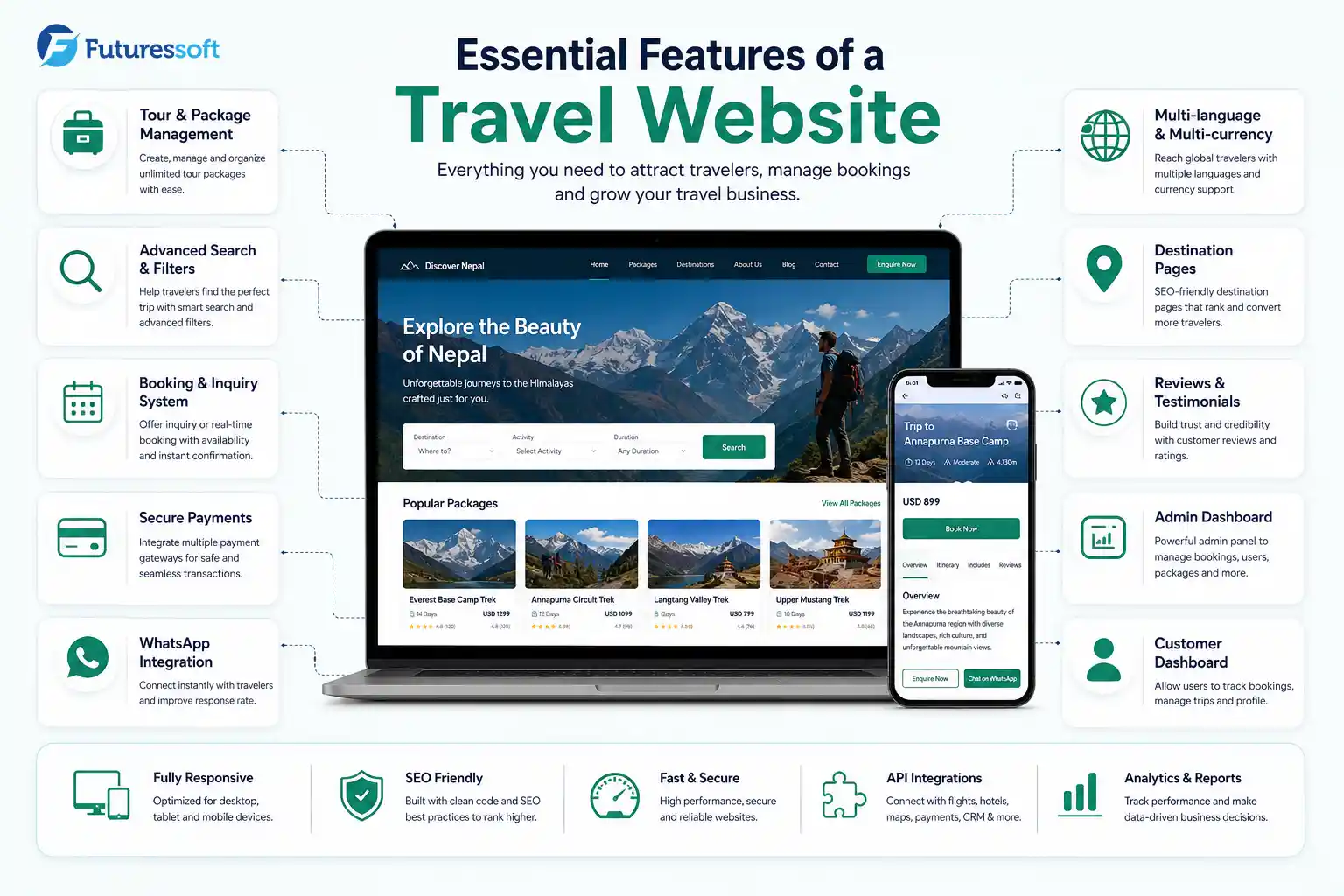
Essential Features of a Travel Website
Regardless of category, a few features have become close to standard for a travel website that's actually expected to perform:
- Tour and package management, with structured itineraries not PDFs
-
Search and filters by destination, activity, duration, or budget
-
Detailed itinerary pages, including inclusions, exclusions, and difficulty
-
Inquiry forms that are short enough that people actually finish them
-
Online booking and payment gateway integration, for Level 3 platforms
-
Customer reviews, shown where people are deciding, not buried on a separate page
-
Dedicated destination pages, built to rank for specific searches
-
WhatsApp integration, since a lot of real conversations still happen there
-
CRM integration, so inquiries are tracked instead of lost in an inbox
-
Multi-language and multi-currency support, for businesses courting international travelers
-
Interactive maps for routes and destinations
-
An availability calendar, where real-time booking is in play
-
A customer dashboard for managing bookings and documents
-
An admin panel the internal team can actually use without training
The mistake we see most often is trying to launch all of this at once. It's usually smarter to get package management, search, and mobile performance right first, then layer in the rest as the business and the traffic grows.
Inquiry-Based Booking vs. Real-Time Booking
One decision shapes almost everything else about a travel website: does it take bookings, or does it take inquiries?
Inquiry-based booking a traveler submits an inquiry, the team reviews availability and details, then confirms manually is the right fit for trekking companies, expedition operators, and customized tours, where group size, permits, and logistics genuinely need a human to confirm.
Real-time booking search, check availability, pay, get instant confirmation fits hotels, flights, activities, and online travel agencies, where the product is standardized enough to sell without a conversation.
A lot of operators assume real-time booking is the "better" option because it feels more modern. In practice, for complex, high-value trips, an inquiry flow that's fast and well-designed often converts better than a booking button that oversimplifies a decision travelers want to think through.
Travel API Integration
Most travel websites are built by connecting a solid core platform to a handful of specialized services, rather than building everything from scratch. Depending on the type of site, that usually includes:
- Flight and hotel APIs, for booking portals
-
Payment gateways, for deposits or full online payment
-
Google Maps, for destinations, routes, and location search
-
Weather APIs, useful for trekking and expedition planning content
-
CRM systems, to route inquiries to the right person automatically
-
Email and SMS systems, for confirmations and reminders
-
WhatsApp and other communication APIs, since that's where a lot of travelers actually want to talk
For a deeper look at how these pieces fit into a full travel platform CRM, ERP, and beyond see our Travel Software Development Guide.
Travel Website SEO: The Part Most Competitors Skip
This is genuinely where a lot of travel websites lose to less polished competitors. Good SEO consistently beats a prettier site with no search strategy behind it.
A few things worth getting right:
- Destination SEO dedicated, well-written pages for each destination, not one generic "where we operate" page
-
Tour package SEO every package as its own indexable page, with real content, not a PDF link
-
Internal linking connecting destination pages, package pages, and blog content so Google (and travelers) can actually find everything
-
Schema markup structured data for trips, reviews, and FAQs, so listings stand out in search results
-
Core Web Vitals a fast, stable-loading site, since Google treats speed as a ranking signal and travelers abandon slow pages fast
-
Blog content strategy route guides, packing lists, permit explainers content that answers the questions travelers search before they book
-
Local SEO for operators competing on destination + location searches
Specific, well-optimized pages for searches like "Everest Base Camp Trek," "Annapurna Circuit Trek," or "Nepal tour package" tend to bring in traffic that's already close to booking-ready a very different kind of visitor than someone landing on your homepage from a generic ad.
Technology Stack for Travel Website Development
The right stack depends on the site's complexity, but a few combinations show up repeatedly across real travel projects:
- Frontend: React, Next.js, or a well-built theme layer on a CMS
-
Backend: Laravel, Node.js, PHP, or WordPress with custom development
-
CMS: WordPress (customized) or a headless CMS for larger, content-heavy platforms
-
Database: MySQL or PostgreSQL
-
Cloud hosting: AWS or DigitalOcean, for reliability during seasonal traffic spikes
For example, the platform we built for Nisraj Tours & Travels runs on a customized WordPress CMS with PHP and MySQL a stack chosen specifically because it lets a non-technical team manage hundreds of packages and destination pages without touching code, while still supporting a fully custom trip-finder and SEO architecture on top.
The right technology choice usually isn't "the newest framework" , it's whatever the team can reliably maintain for years, since a travel website is a long-term asset, not a one-off project.
What Does Travel Website Development Cost?
Costs vary a lot depending on the number of packages, whether you need real-time booking or an inquiry flow, how many integrations are involved, and how much custom design work is required. Rather than guessing at a number here, we've broken the full pricing picture down separately in Travel Website Development Cost in Nepal worth a read once you have a sense of which level of website (informational, lead-gen, or full booking portal) fits your business.
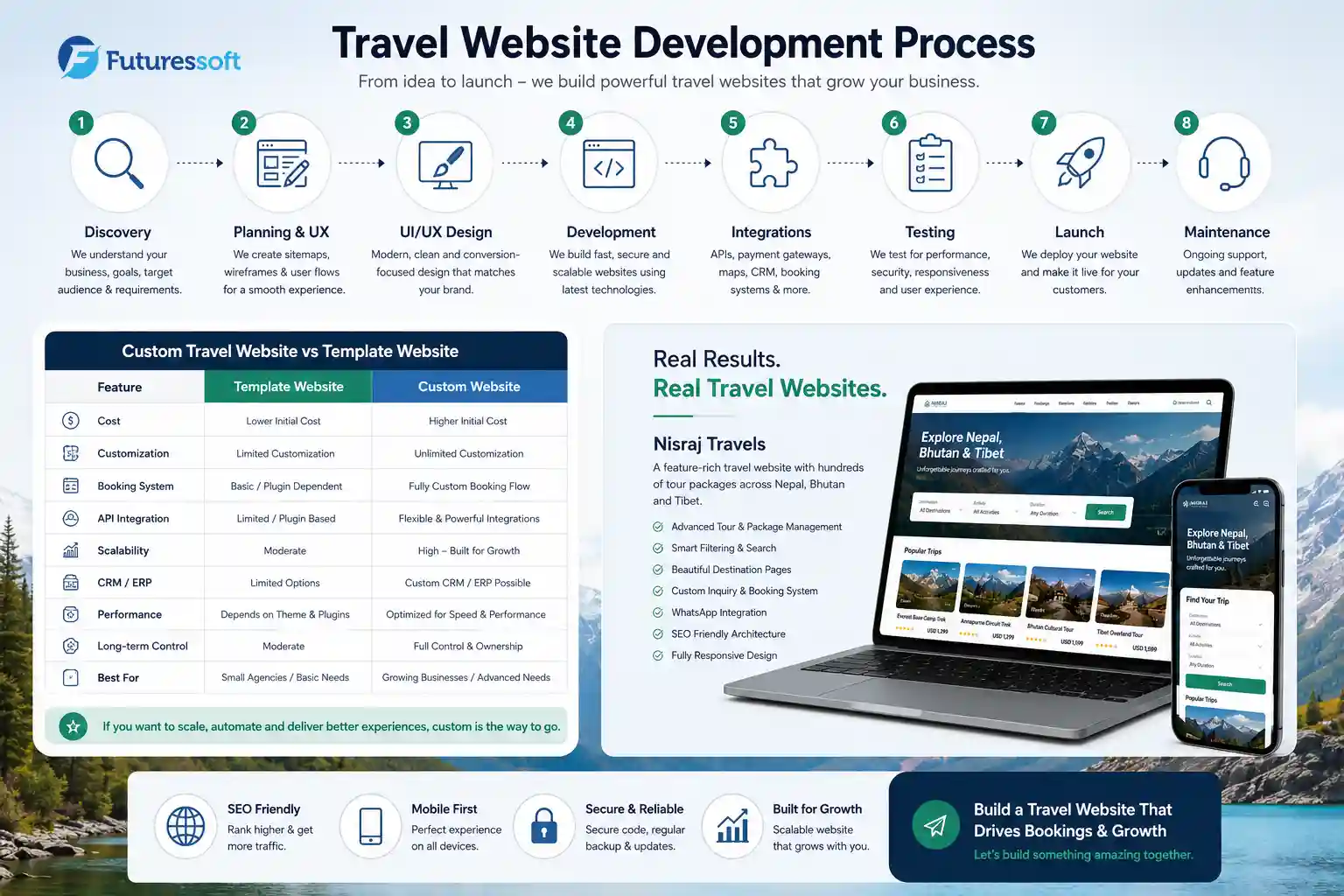
Travel Website Development Process
A well-run travel website project generally moves through the same stages, regardless of size:
- Discovery understanding the packages, destinations, and booking process you already run
-
Wireframing mapping out the structure before any design work begins
-
UI/UX design designing the package pages, search flow, and admin dashboard
-
Development building the frontend, backend, and integrations
-
API integration connecting maps, payments, CRM, and communication tools
-
Testing across devices, browsers, and critically the actual booking or inquiry flow
-
Deployment launching with proper hosting, SSL, and backups in place
-
Maintenance updates, security patches, and new content as the business grows
Skipping straight from "discovery" to "development" is the most common shortcut we see backfire; it usually means redesigning the booking flow halfway through the build.
Custom Travel Website vs. Template Website
|
Factor |
Template Website |
Custom Website |
|
Initial cost |
Lower |
Higher |
|
Customization |
Limited |
Unlimited |
|
Booking workflow |
Basic |
Built around your actual process |
|
API integration |
Limited |
Extensive |
|
Scalability |
Moderate |
High |
|
CRM integration |
Plugin-based |
Native |
|
Long-term growth |
Limited |
Excellent |
A template is a reasonable starting point for a small, Level 1 informational site. Once you're managing hundreds of packages, multiple destinations, or a real inquiry pipeline, the limits of a template stop being a minor annoyance and start actively costing bookings.
Travel Website Development for Nepal Travel Companies
Nepal's travel and tourism sector trekking companies, tour operators, adventure travel businesses, DMCs, pilgrimage tour providers, and luxury travel companies has a specific set of website needs that generic travel platforms often miss: permit information, altitude and difficulty details, seasonal trekking windows, and multi-country itineraries spanning Nepal, Bhutan, and Tibet.
A trekking company's website needs to sell confidence in the route and the guides as much as the destination itself. That's a different job than a hotel booking page, and it's worth building for specifically rather than adapting a generic travel template.
Why Choose Futuressoft for Travel Website Development
We're a software development company based in Lalitpur, Nepal, and travel is one of the sectors we've worked in directly, not just in theory.
Our platform for Nisraj Tours & Travels, a Nepal-based adventure travel company running trekking, expedition, peak climbing, mountain biking, and cultural tours across Nepal, Bhutan, and Tibet, is a good example of what this looks like in practice. The business needed to organize hundreds of packages across three countries and several activity categories, and make it genuinely easy for a traveler to find the right trip for their timeframe, budget, and interests.
We built:
- An advanced trip finder filtering by destination, activity, duration, budget, and region
-
Dedicated destination pages for Nepal, Bhutan, and Tibet, plus category pages for trekking, expeditions, peak climbing, mountain biking, and hiking
-
A package management system letting the Nisraj team update itineraries, pricing, and galleries without touching code
-
A mobile-first design, since most adventure travelers research trips on their phones
-
SEO-friendly architecture clean URLs, optimized metadata, and blog integration to support organic visibility long after launch
-
Custom inquiry forms and WhatsApp integration, turning browsing into actual conversations with the sales team
The result moved Nisraj from a brochure-style presence to a searchable, lead-generating platform with room to keep growing.
The Bottom Line
A travel website that actually works for the business does a few things well: it attracts the right traffic, turns that traffic into inquiries or bookings, makes packages easy to manage on the back end, gives travelers a clear and trustworthy experience, and can grow as the business adds destinations and packages.
If your current site or your Facebook page standing in for one has stopped feeling like a growth engine and started feeling like the bottleneck, that's usually the sign it's time for a proper conversation about what to build next.
Schedule a call with Futuressoft to talk through what a travel website built around your actual packages, destinations, and customers would look like.
Related Insights